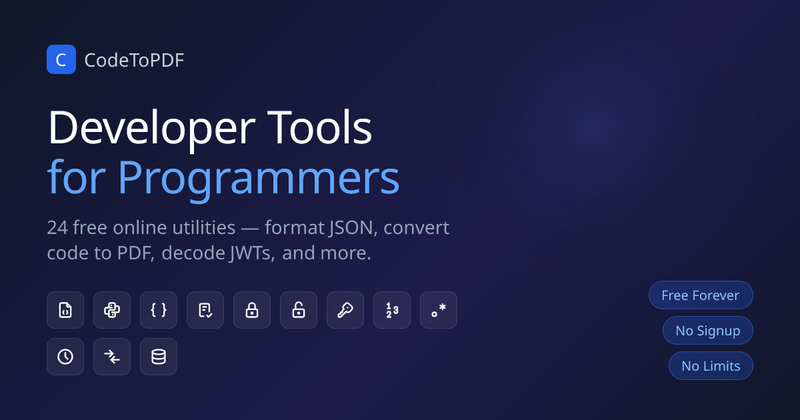
CodeToPDF is a free, no-signup collection of 24 browser-based developer tools whose flagship utility converts source code in more than 50 programming languages into syntax-highlighted PDF documents.
What is CodeToPDF?
CodeToPDF is an online toolkit for programmers that bundles 24 utilities across PDF conversion, code formatting, encoding and decoding, generation, and everyday developer tasks. You paste or upload inputs — source files, JSON, JWT tokens, SQL, YAML, HTML, Markdown, a public URL — and get back a downloadable artifact or an inspected result: a themed PDF, an indented and validated document, decoded token claims, a v4 UUID batch, or a PNG/SVG QR code. Most tools run entirely inside the browser, while PDF generation and code execution happen in a cloud sandbox that deletes files immediately after processing. No account, no signup, and a dark mode are included.
Key Features
- Code to PDF Converter — drag-and-drop multiple source files across 50+ languages including JavaScript, Python, Java, Go, and Rust, choose a theme such as Dracula or Monokai, set font and page size, and download a print-ready PDF.
- Language-specific PDF sandboxes — Python Code to PDF runs scripts in a secure cloud sandbox pre-loaded with PyMuPDF, ReportLab, Matplotlib, Pandas, and Seaborn to emit PDFs, charts, and reports; Node.js Code to PDF ships with pdfkit and jspdf.
- Document converters — Markdown to PDF preserves headings, code blocks, tables, and lists; HTML to PDF handles CSS, flexbox, tables, and Google Fonts pixel-accurately; Web Link to PDF captures any public URL; LaTeX to PDF compiles via pdflatex.
- Formatters and validators — JSON Formatter, JSON Validator (reports exact error line and column), JSON Compare (side-by-side diff with dot-notation paths), SQL Formatter for MySQL, PostgreSQL, SQLite, T-SQL and BigQuery, plus HTML, CSS, XML, and YAML formatters that also convert YAML to JSON.
- Encoders and decoders — Base64 encode and decode supporting both standard and URL-safe alphabets with error detection, and a JWT Decoder that shows header, payload, expiry, and every claim without sending the token to a server.
- Generators — a cryptographically secure v4 UUID generator that bulk-produces up to 100 IDs at a time, and a QR code generator with PNG or SVG export, adjustable size, colours, and error-correction level.
- Developer utilities — a regex tester with live match highlighting, capture groups, and real-time match counts; a Unix timestamp converter handling seconds and milliseconds in UTC or local time; a GitHub Flavored Markdown preview with tables, code blocks, and task lists; and JSON to TypeScript interface generation.
- Privacy by default — client-side tools process data locally, server-side PDF tools enforce zero retention, inputs are never logged, and every tool is free with no credit limits or paywall.
Who should use CodeToPDF?
- Software engineers debugging API responses: paste payloads into the JSON Formatter and Validator to find the exact line and column of a syntax error, or compare two responses side by side with JSON Compare.
- DevOps engineers: format and validate Kubernetes YAML, CI/CD pipeline files, and Ansible playbooks, converting between YAML and JSON as needed.
- Data scientists and analysts: run Python in the cloud sandbox with Pandas, Matplotlib, and Seaborn to turn scripts into downloadable PDF charts and reports.
- Technical writers, researchers, and students: render Markdown, HTML, or LaTeX source into styled PDFs for documentation, papers, and academic submissions.
What can you do with CodeToPDF?
- Preparing code for review or delivery: drop Python, JavaScript, Go, or Rust files into the Code to PDF tool, apply a Dracula or Monokai theme, and hand over a syntax-highlighted PDF instead of raw text snippets.
- Inspecting authentication tokens: decode a JWT in the browser to read its header, payload, expiry timestamp, and claims — the tool is decode-only and nothing is sent to a server.
- Formatting database queries: paste MySQL, PostgreSQL, SQLite, T-SQL, or BigQuery SQL and get consistently indented output for documentation or code review.
- Converting live pages or markup to PDF: turn any public URL or an HTML document with CSS, flexbox, and Google Fonts into a pixel-accurate PDF.
Pricing
CodeToPDF is free. Every one of the 24 tools is usable without an account, credit limit, or paywall, and the site states the tools will remain free.
FAQ
Is CodeToPDF free to use?
Yes. All 24 live tools are free with no account, no credit limits, and no paywall. The site states there are no freemium tricks; new tools are added over time on the same free model.
Are my files or data stored on CodeToPDF servers?
No. Client-side tools such as the JSON Formatter, JWT Decoder, Base64 tools, UUID generator, and regex tester run entirely in your browser. For server-side PDF conversion, files are deleted automatically and immediately after processing under a zero-retention policy, and inputs are never logged.
How many languages does the Code to PDF converter support?
More than 50, including JavaScript, Python, TypeScript, Java, Go, and Rust. You can drag and drop multiple files at once, pick a syntax theme, configure font and page size, and download a print-ready PDF.
Do I need to create an account or sign up?
No account is required for any tool. There is no signup step, and the interface includes a dark mode toggle plus a command-style search bar for finding tools by name, format, or task.
Can CodeToPDF run code, not just convert files?
Yes. Python Code to PDF executes scripts in a secure cloud sandbox with PyMuPDF, ReportLab, Matplotlib, Pandas, and Seaborn available, and Node.js Code to PDF runs JavaScript with pdfkit and jspdf pre-loaded so you can generate PDFs programmatically.