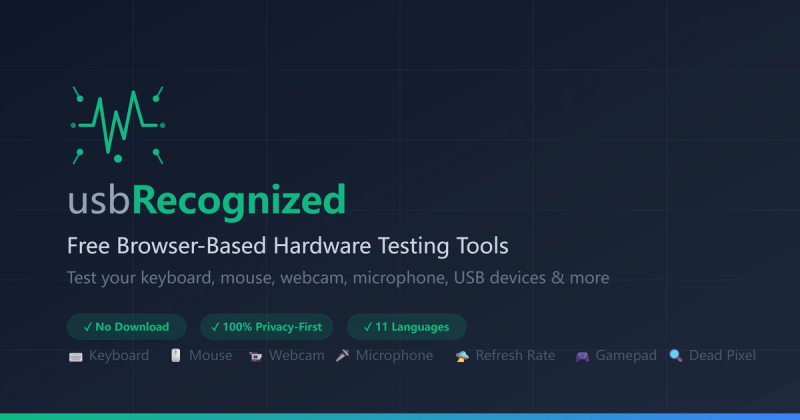
usbRecognized is a browser-based hardware diagnostics site that tests keyboards, mice, displays, webcams, microphones, and USB devices directly in Chrome, Edge, Firefox, Safari, or Opera without installing software.
What is usbRecognized?
usbRecognized is an online hardware testing platform from usbRecognized.com that runs device diagnostics entirely client-side using Web APIs such as WebHID, WebUSB, WebRTC, MediaDevices, WebGPU, and WebGL. You open a tool page, grant browser permissions when prompted, interact with the hardware by pressing keys, clicking, speaking, or plugging in a USB device, and receive a report or health score. It supports Windows, macOS, Linux, and Android with any modern browser, and it also offers a 24-language interface. No account or backend processing is involved.
Key Features
- Quick Device Check — one-click scan that tests keyboard, mouse, touch support, webcam, microphone, screen resolution, refresh rate, battery, and browser capabilities, then produces a Hardware Health Report with a score and recommended follow-up tools.
- Keyboard Tester — visual keyboard layout with NKRO measurement, ghosting detection, chattering switch checks, and key press latency testing for mechanical, membrane, laptop, and Bluetooth keyboards.
- Mouse Test — verifies left, right, middle, and side buttons, measures clicks per second (CPS), tests double-click detection, and checks scroll wheel functionality.
- Display diagnostics — separate tools for refresh rate timing, dead pixel detection at pixel level, color test, screen bleeding, contrast, color banding, greyscale, and frame rate.
- Audio and camera tools — Microphone Test, Speaker Test, Stereo Test, and Webcam Test with camera preview, resolution and frame rate checks, and microphone input level measurement.
- USB and device info — USB Device Check, USB Device Info with VID/PID lookup, Printer Test, Browser Info, and Screen Resolution.
- Device Health dashboard — aggregates all test results into one dashboard with cross-device correlation analysis.
- Local-only processing — keystrokes, camera feed, microphone audio, and USB device info stay in your browser; the site is statically generated with no backend processing test data. Unobtrusive ads and Google Analytics are the only external requests per the FAQ.
Who should use usbRecognized?
- PC and laptop owners troubleshooting peripherals: check whether a keyboard has chattering switches, a mouse has a failing button, or a monitor has dead pixels before buying replacements.
- Gamers: measure keyboard NKRO and latency, mouse CPS and double-click behavior, refresh rate timing, and frame rate to verify competitive hardware performance.
- Remote workers and streamers: confirm webcam resolution and frame rate and test microphone input levels before calls or recordings.
- IT support and repair technicians: run USB device enumeration with VID/PID lookup, printer checks, and consolidated device health reports for quick diagnostics.
- Mobile users: test touch screens, touchpads, and on-screen keyboards from a phone or tablet browser.
What can you do with usbRecognized?
- Diagnose keyboard faults: press keys on a visual layout to detect ghosting, chattering, or missing key registrations and see NKRO counts.
- Verify mouse performance: click each button and measure CPS and double-click detection to confirm a mouse is working correctly.
- Check display quality: run dead pixel, color banding, screen bleeding, contrast, greyscale, and refresh rate tests to find panel defects.
- Test audio and video readiness: preview webcam feed, check camera resolution and frame rate, and measure microphone input levels before a meeting or stream.
- Inspect USB devices: scan and enumerate USB hardware with VID/PID lookup, and test printers, in browsers that support WebUSB.
- Get an overall device score: run Quick Device Check and view aggregated results in the Device Health dashboard.
How does usbRecognized work?
usbRecognized follows four steps: open a specific tool or the Quick Device Check, allow browser permission for camera, microphone, or USB access when prompted, interact with the device under test, and view an instant report with a health score and recommendations. Tests run client-side; some advanced features like WebUSB scanning and WebHID require Chrome or Edge. Basic keyboard, mouse, and display tests work in any modern browser.
Pricing
All tools on usbRecognized are free with unlimited tests, no registration, no download, no paywall, and no premium tiers. The site is supported by unobtrusive advertising; Google Analytics collects anonymous page view statistics.
Pros and cons
- Pros: free unlimited tests, no installation, local-only processing, cross-platform browser support, detailed diagnostics beyond pass or fail, and 24-language support.
- Cons: advanced WebUSB and WebHID features require desktop Chrome or Edge; some USB devices need specific drivers or permissions; mobile browsers support most tests but not the advanced desktop-only hardware APIs.
FAQ
Is usbRecognized free?
Yes. Every tool is free to use with unlimited tests, no account, no download, and no hidden fees. The site is supported by unobtrusive advertising and has no premium tiers or paywalls.
Do I need to install anything to test my hardware?
No. usbRecognized runs in the browser using standard Web APIs. Basic keyboard, mouse, and display tests work in any modern browser, but advanced WebUSB scanning and WebHID require Chrome or Edge.
Is my testing data uploaded anywhere?
No. Keystrokes, camera feed, microphone audio, and USB device information stay on your computer. The site is statically generated with no backend processing test data; you can verify this in your browser's Developer Tools Network tab.
Which browsers and devices are supported?
Chrome, Edge, Firefox, Safari, and Opera are supported. Basic tests work on Windows, macOS, Linux, and Android, and most tests work on mobile browsers. WebUSB and WebHID advanced features need desktop Chrome or Edge.
Why isn't my USB device detected?
USB detection requires the WebUSB API, which is available only in Chrome and Edge. Some USB devices also need specific drivers or permissions. Click the Connect button and select the device from the browser's USB device picker.