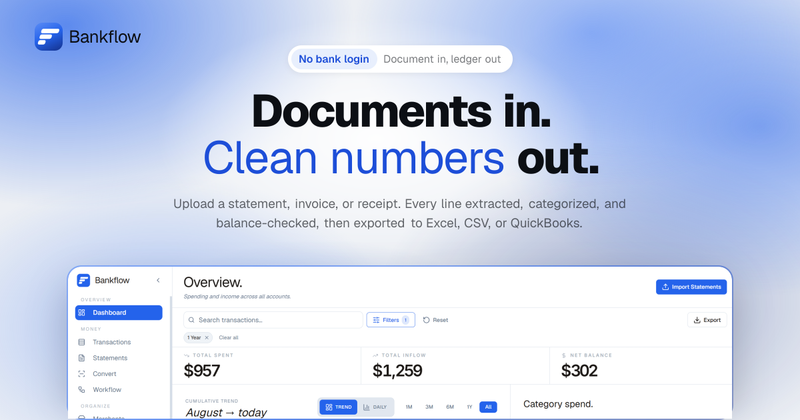
Bankflow is a web app that converts bank statements, invoices, and receipts into structured ledgers, exporting them as Excel, CSV, JSON, or files shaped for accounting software — all from uploaded documents rather than a linked bank account.
What is Bankflow?
Bankflow is a financial document processor that reads bank statements, invoices, and receipts and returns clean transaction data you can export. It accepts PDFs, phone photos, CSV, Excel, and JSON files (scanned and password-protected files included), then outputs Excel, CSV, or JSON, plus OFX, QBO, QFX, QIF, IIF, and ledgers shaped for Xero, QuickBooks, Sage, MYOB, and NetSuite. It runs in the browser, requires no bank login, and is made by Bankflow.
What makes Bankflow stand out?
- Template-free parsing — There is no bank to select from a list and no template to configure; dates, descriptions, amounts, and balances are located on the page itself, including layouts it has never seen.
- Balance-level reconciliation — Every statement is checked against its own opening and closing figures, so a missed row surfaces as a number that does not add up rather than a silent gap (example: opening US$356.41, money in US$3,921.69, printed close US$578.46).
- A review step before export — Each figure sits beside the page it came from with balances proved against the printed close, so you can correct values before they count.
- Categorisation and reusable rules — Rows arrive with a category and identified merchant; match/tag/scope rules run across already-imported history and future imports (for example, including NETFLIX, SPOTIFY, DISNEY+ as Entertainment/Streaming).
- Automated intake — Forward statements to [email protected], or let a workflow watch a Google Drive, OneDrive, or Dropbox folder.
- API access — A documented endpoint (POST /api/v1/parse with a bearer token) returns parsed transactions programmatically; every plan includes the API.
- Cashflow and runway views — Parsed statements roll into monthly P&L, projections, and three runway views: net burn, essentials-only, and zero-income.
- Wide document support — 5 import formats across twelve file extensions and 12 export formats, with statement layouts designed for institutions including HSBC, Wells Fargo, Revolut, Monzo, Mercury, Barclays, N26, DBS, HDFC Bank, Nubank, Wise, and Chase.
Who should use Bankflow?
- Bookkeepers and accountants: batch-convert client statement PDFs into QBO, OFX, QIF, or Xero-ready ledgers instead of retyping rows into a spreadsheet.
- Small business owners and freelancers: upload monthly statements to get categorised spend and income across all accounts without linking online banking.
- Founders and finance leads: feed parsed statements into the monthly P&L and net burn, essentials-only, and zero-income runway views.
- Anyone with paper receipts: photograph an invoice or receipt on a phone and get vendor, date, line items, and totals checked against the printed document, exportable as QuickBooks or Xero bills.
What can you do with Bankflow?
- Export a statement to Excel or CSV: upload a bank statement PDF, review every extracted figure against its source page and the printed closing balance, then download a spreadsheet.
- Automate statement intake: forward statements to a dedicated import address or point a workflow at a Drive, OneDrive, or Dropbox folder so documents are parsed without manual uploading.
- Convert receipt photos into bills: snap a receipt or invoice on your phone and export the line items as Excel, CSV, JSON, QuickBooks bills, or Xero bills.
- Track runway: roll parsed transactions into monthly P&L and projections to see runway under net burn, essentials-only, and zero-income assumptions.
How does Bankflow work?
- Drop the document in — a statement PDF, a spreadsheet, or a phone photo of an invoice or receipt. No bank login and no template to pick first.
- Check what it read — every figure lands beside the page it came from, with balances proved against the printed close, and anything questionable flagged to correct.
- Export it where it goes — Excel, CSV, or JSON, or a ledger shaped for Xero, QuickBooks, Sage, or MYOB.
Pricing
Bankflow is freemium: Free at $0 with 50 one-time credits, Starter at $14.99 per month for 300 credits a month, Pro at $39.99 per month for 1,000 credits a month, and Business at $99.99 per month for 3,000 credits a month. Credits run roughly one per page, every plan includes every feature and the API, and yearly billing saves about two months.
FAQ
Do I need to link my bank account?
No. Bankflow works from the documents themselves — you upload a statement PDF or a receipt photo, or forward statements to an import address, and no bank credentials or online-banking connection are involved.
It accepts 5 import formats — PDF, photo, CSV, Excel, and JSON — across twelve file extensions, including scanned and password-protected files. It exports to 12 formats: CSV, Excel, JSON, OFX, QBO, QFX, QIF, IIF, and ledgers shaped for Xero, Sage, MYOB, and NetSuite.
How accurate is the parsing?
Bankflow reconciles each statement against its own opening and closing figures, so a missed transaction shows up as a total that does not tie out instead of a silent gap, and the review step lets you correct anything before exporting.
Is there a free plan?
Yes. The Free plan includes 50 one-time credits, roughly one credit per page, with no card required — enough to run a real statement through before deciding on a paid tier.