Image2Layer is a browser-based AI image-to-layers converter that splits one flat JPG, PNG, or WebP into independently editable layers — subjects, foreground objects, text and logo graphics, cast shadows, and a rebuilt background — and exports them as transparent PNG layers, a structured ZIP, or a layered PSD.
What is Image2Layer?
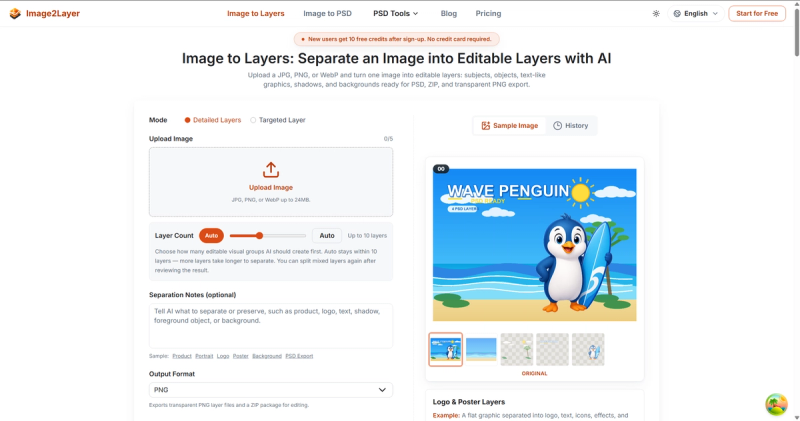
Image2Layer is a web app that takes a single flattened raster image (JPG, PNG, or WebP up to 24 MB) and returns a stack of separate, editable layer files instead of one cutout. Its AI detects major subjects, objects, text-like graphics, shadows, and background regions, then rebuilds the hidden areas behind foreground elements so moved or removed objects leave no empty gaps. Output is a layered PSD for Photoshop, transparent PNG layer files, or a ZIP package. It runs in the browser with no install, and new users get 10 free credits after sign-up with no credit card required.
What makes Image2Layer stand out?
- Semantic layer separation — detects subjects, objects, text, shadows, and backgrounds and converts each into its own editable layer rather than producing a single subject mask.
- Background reconstruction — rebuilds the areas hidden behind foreground elements so you can move or delete objects without leaving holes in the background layer.
- PSD and PNG export — outputs a layered PSD openable in Photoshop, plus transparent PNG layers packaged in a ZIP.
- Layer count control — choose Auto or set a specific number of editable visual groups, capped at 10 layers; higher counts take longer to separate, and mixed layers can be split again after review.
- Two modes — Detailed Layers for a full layer stack, or Targeted Layer for isolating a specific element.
- Separation notes — an optional text field with sample hints such as Product, Portrait, Logo, Poster, and Background to steer what gets separated.
- Input limits — accepts JPG, PNG, and WebP up to 24 MB, with a 0/5 upload counter in the interface.
Who should use Image2Layer?
- Product marketing designers — break campaign visuals into product, label, prop, and shadow layers, then rebuild layouts for ads and landing pages using the PSD export.
- Motion designers and animators — pull character, hair, accessory, clothing, shadow, and background layers out of flat character art before animating, instead of tracing masks by hand.
- Game artists — prototype layered assets from concept images by separating subjects, props, and background planes for faster iteration.
- Brand designers and retouchers — pull logos, text, and backgrounds out of flattened client graphics as a structured starting point for redesign work.
What can you do with Image2Layer?
- E-commerce creatives: isolate a product, keep its cast shadow, and rebuild a clean background for new banners and product pages without reshooting.
- Social and thumbnail producers: move subjects around and test new compositions without rebuilding the whole graphic from scratch.
- Poster and print designers: separate typography, graphics, effects, objects, and background from a flat poster into editable layers for revisions.
How does Image2Layer work?
- Upload one JPG, PNG, or WebP up to 24 MB; Image2Layer reads the composition.
- Choose Detailed Layers or Targeted Layer, set a layer count (Auto or up to 10), optionally add separation notes, and run the separation — each generation uses 20 credits.
- Preview the split (for example product subject, cast shadow, product labels, foreground prop, rebuilt background) and export as transparent PNG layers, a ZIP package, or a layered PSD.
Pricing
Image2Layer follows a freemium credit model: new users receive 10 free credits after sign-up with no credit card required, and each layer generation consumes 20 credits — so the free balance covers less than one full generation. No dollar amounts or paid tier names are published on the page.
FAQ
It accepts JPG, PNG, and WebP files up to 24 MB. The interface shows a 0/5 upload counter, so images are uploaded in small batches rather than unlimited bulk queues.
How many layers can Image2Layer create from one image?
You can let Auto decide or set the count yourself, capped at 10 editable visual groups. More layers take longer to separate, and any mixed layer can be split again after you review the result.
Can I export the result as a layered PSD?
Yes. Image2Layer exports a layered PSD that opens in Photoshop, transparent PNG layer files, or all layers bundled in a structured ZIP package — covering both design-tool and quick-compositing workflows.
How is Image2Layer different from background removal?
Background removal returns one cutout. Image2Layer separates multiple semantic layers — subject, foreground objects, text, shadows, and background — and reconstructs hidden background areas behind removed objects so the remaining layers stay usable.