Gesture instruments usually end at the demo
There is no shortage of webcam hand-tracking music toys. Almost all of them stop at the same place: it is fun for ninety seconds, it makes a noise, and then there is no way to get anything out of it. The performance evaporates when you close the tab.
Gesture Synth Weld exports a real .mid file. Whatever you play with your hands becomes MIDI you can drag into Ableton, Logic, FL Studio or any other DAW and edit like you recorded it on a keyboard. That single feature is what turns it from a toy into an input device.
Three ways to play
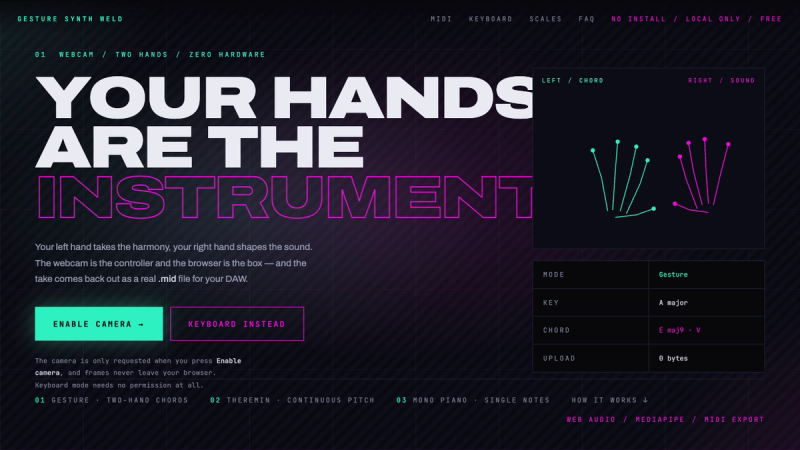
Gesture mode. Left hand picks the chord, right hand controls volume and tone. Two hands, independent roles — closer to playing an instrument than triggering samples.
Theremin mode. Height maps to pitch as one continuous, sliding voice. No quantisation, no discrete steps.
Mono piano mode. One note at a time. The simplest way to learn where the notes of a scale sit before you add chords.
Musical controls that matter
- 9 scale modes, with the option to lock to scale so wrong notes are not reachable
-
- Wrist tilt to switch between major and minor within the scale
-
- Finger layout mapping, from triad up to 9th chords
-
- Arpeggiator at off / slow / normal / fast
-
- Background bass and metronome to play against
-
- Single-hand mode when you only have one hand free
Keyboard mode, no camera needed
If there is no webcam, or you are somewhere you do not want one on, the whole instrument is playable from the computer keyboard. Same scales, same export.
Local only — 0 bytes uploaded
Hand tracking runs in the browser. No video leaves the machine, there is no account, and the site states the number plainly: 0 bytes uploaded. Free, no sign-up, no install.