GEO Checker is an AI search visibility and Generative Engine Optimization (GEO) tool that helps teams measure how their brand appears in AI-generated answers from major AI engines.
What is GEO Checker?
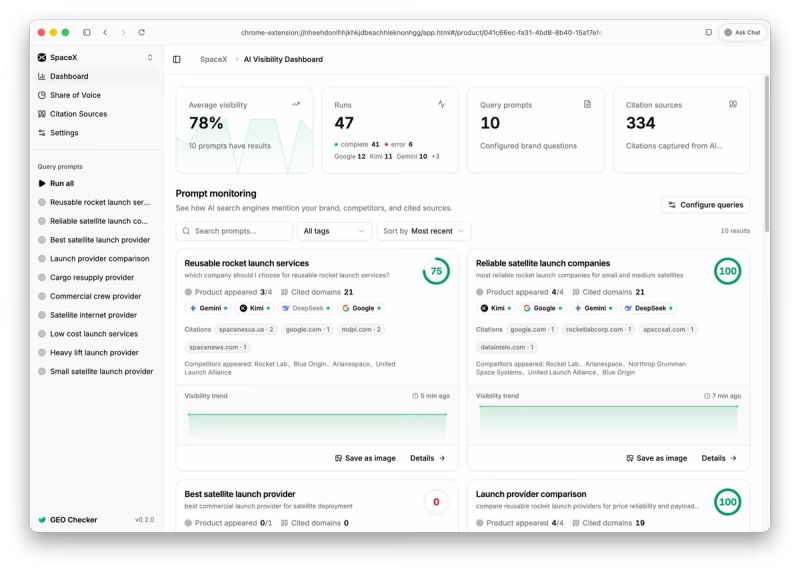
GEO Checker is a browser extension (with a complementary website) that analyzes how a product or website is mentioned by AI assistants such as ChatGPT, Claude, Gemini, Grok, DeepSeek, Perplexity, and others. It takes as input a product name, website URL, aliases, competitors, and custom prompts, then runs those prompts across AI engines directly from the user's browser. The output is a dashboard showing visibility percentages, per-run summaries, citation links, cited domains, competitor mentions, and trends over time. It is developed by the team behind Geo Checker.
Key Features
- AI Visibility Dashboard — Tracks product mentions, competitor mentions, citation links, and cited domains across ChatGPT, Claude, Gemini, Grok, DeepSeek, Kimi, Doubao, Perplexity, and Google AI mode.
- Custom Prompt Management — Users define their own prompts and competitor lists, then run them against multiple AI engines in parallel from their own browser sessions.
- Local-First Architecture — All data (prompts, AI sessions, captured answers, results) stays in the browser without requiring a GEO Checker account, hosted backend, or API keys.
- AI Readiness Check — The website offers a free GEO readiness analysis for any URL, evaluating content structure, authority signals, and citation-friendliness based on six key GEO strategy elements.
- Trend Analysis — Visibility trends over time help teams see whether their AI mention frequency is improving after content updates.
- Cross-Engine Comparison — Compare how the same prompt performs across different AI models to identify citation gaps and opportunities.
Who is it for?
- Founders and product teams — to monitor whether AI assistants mention their product for high-intent search prompts and compare against competitors.
- SEO and content teams — to identify which domains are cited instead of their own, which prompts need better content support, and which pages need clearer structure or stronger authority signals.
- Marketers — to track brand visibility in AI-generated answers and measure the impact of GEO optimization efforts on citation frequency.
What can you do with GEO Checker?
- Monitor brand mentions in AI answers — Set up your product name, aliases, and competitors, then run prompts to see which AI engines mention your brand and how often.
- Identify citation opportunities — Discover which domains are cited for your target prompts and which sources you should earn mentions from to improve citation rates.
- Optimize content for AI citations — Use the AI readiness check to get specific recommendations on content clarity, authority signals, and direct answer structure.
- Compare AI engine behavior — See whether ChatGPT, Gemini, Perplexity, or others cite your content differently and adjust your strategy per platform.
How does GEO Checker work?
- Install the browser extension (or use the website). 2. Configure your product name, website URL, aliases, competitors, and the prompts you care about. 3. Run those prompts across AI engines from your own browser sessions. 4. GEO Checker captures the answer text, product mentions, competitor mentions, citation links, and cited domains. 5. The dashboard visualizes visibility percentage, per-run summaries, source lists, citation groups, competitor presence, and trends over time.
FAQ
What is GEO (Generative Engine Optimization)?
GEO stands for Generative Engine Optimization. It refers to content optimization strategies for AI-driven search engines, with the goal of increasing brand content visibility in AI-generated responses. Unlike traditional SEO which focuses on search result rankings, GEO focuses on getting AI to directly reference or mention your content in answers.
What's the difference between GEO and traditional SEO?
SEO centers on webpage rankings using keywords and backlinks. GEO centers on AI model citations, requiring clear content structure, semantic relevance, and high information density. In the GEO era, what matters is how often your content is cited by AI models (citation rate), not just page rankings.
Does GEO Checker require an account or API keys?
No. GEO Checker is local-first. It does not require a GEO Checker account, a hosted backend, or API keys. All data stays in your browser.
Which AI engines does GEO Checker support?
It supports ChatGPT, Claude, Gemini, Grok, DeepSeek, Kimi, Doubao, Perplexity, and Google AI mode.
Is GEO Checker free?
Yes. The website provides a free GEO readiness check for any URL. The browser extension is also free to use.