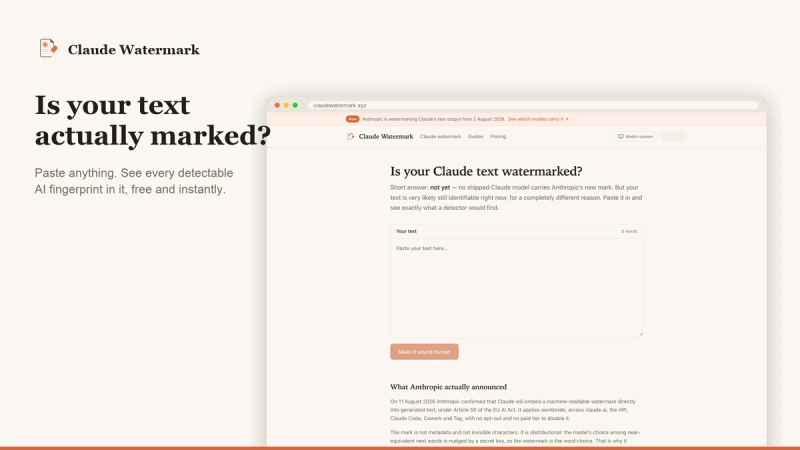
Anthropic is watermarking Claude's text. Tools selling "watermark removal" strip invisible Unicode — which cannot touch that mark, because it is distributional: a secret key biases word choice, so the watermark IS the wording.
Paste text and see, in your browser, every fingerprint a detector actually finds: the HTML classes copy-paste leaves behind (what the AO3 Claude detector checks), zero-width characters, odd spaces, stylistic tells. Nothing is uploaded.
One button then cleans those artifacts and rewrites the prose in two passes. Free to check. 10 credits on signup, no card.
What the checker actually looks at
Paste any passage and the analyzer runs entirely client side. It flags the leftover HTML classes that Claude's web interface bakes into copied text, zero-width and invisible Unicode characters, non-breaking and narrow spaces, curly-quote and em-dash patterns, and the stylistic tells that human readers and automated detectors both key on. Every check happens in your own browser tab, so nothing you paste is transmitted, logged, or stored on a server.
Why "watermark remover" tools mislead you
Most tools marketed as watermark removers do one thing: strip invisible characters. That is worth doing, but it does not touch Anthropic's actual watermark. The published approach is distributional. A secret key nudges the model's token probabilities, so the mark lives in which words were chosen, not in any hidden character you can delete. The only thing that removes a distributional watermark is changing the wording itself.
What the cleaner does
The cleanup pass first normalizes every artifact the checker found, then rewrites the prose in two passes so the token distribution no longer matches the original generation. You keep the meaning and the structure; the fingerprint goes.