AI assistants like ChatGPT and Claude are useful for research and writing, but they have a well-documented failure mode: hallucinated citations. A reference can look completely legitimate — plausible title, real-sounding authors, a properly formatted DOI — and still not correspond to any actual paper, or point to the wrong one entirely.
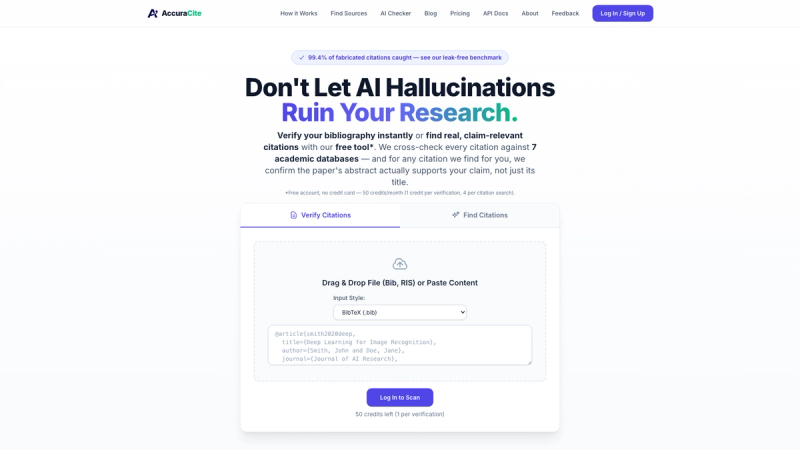
AccuraCite (https://accuracite.com) checks citations against six real academic databases — OpenAlex, Crossref, Semantic Scholar, PubMed, DBLP, and arXiv — confirming whether a reference exists, whether its DOI resolves correctly, and whether the authors, title, and year actually match. Paste in a reference list or upload a document, and get a clear verified / mismatch / not-found result for each one, instead of manually cross-checking citations by hand.
AccuraCite also works in the other direction: given a claim that needs sourcing, it finds real published papers that actually support it, not just papers with similar-sounding titles.
A REST API (https://accuracite.com/api-docs) and an MCP server (https://www.npmjs.com/package/accuracite-mcp) are both available, so citation verification can run inside existing research or writing tools rather than as a separate manual step. Built by a PhD computer scientist, for researchers, students, journal editors, and anyone submitting AI-assisted work who can't afford to cite something that doesn't exist.