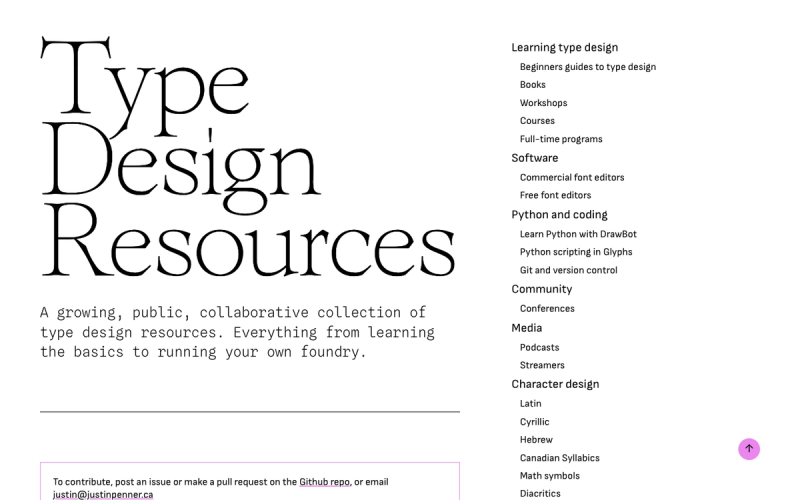
Type Design Resources is a public, collaborative, and meticulously organized directory that curates hundreds of links to learning materials, software, community groups, tools, and best practices for type design and font production.
What is Type Design Resources?
Type Design Resources is a free, community-driven website that aggregates and categorizes links to the best available content for anyone learning or practicing type design. It takes no user input except through community contributions via GitHub or email, and outputs a browsable, sectioned directory of external resources. The site is maintained by Justin Penner and lives on the open web at typedesignresources.com.
Key Features
- Comprehensive learning paths — Covers everything from beginners’ guides (e.g., Design with FontForge) to full-time master’s programs (Type & Media at KABK, Type West). Each section includes multiple options, with pricing and platform notes.
- Software catalog — Lists 19 font editors, both commercial (Glyphs, RoboFont, FontLab) and free/open‑source (FontForge, Fontra), with direct download links and price/OS details.
- Character design guidance — Dedicated sections for Latin, italic, Cyrillic, Greek, Hebrew, Canadian Syllabics, math symbols, and box‑drawing characters, each linking to authoritative guides and discussions.
- Community and events — Links to forums (TypeDrawers), conferences (ATypI, TypeCon), podcasts (Creative Characters, Type Radio), and streaming channels where designers show real‑time work.
- Technical tooling — Curated lists of kerning tools (Kern On, BubbleKern), proofing software (Font Goggles, Font Proofer), and font‑engineering utilities (Fontbakery, fontTools).
- Practical business resources — Covers open‑source licensing (SIL Open Font License), font naming, selling on marketplaces (Fontspring, Monotype), and type specimen design.
Who is it for?
- Aspiring type designers — Can start with the beginners’ guides and work through structured courses listed under “Learning type design”.
- Professional type designers — Use the software comparisons, advanced character design guides, and font‑engineering tools to refine production workflows.
- Foundry owners — Refer to the “Selling your fonts” and “Open‑source your fonts” sections for licensing, distribution, and marketing advice.
- Typography educators — Use the curated reading lists, workshop programs, and proofing texts to build course materials.
What can you do with Type Design Resources?
- Learn type design from scratch — Follow the beginner tutorials (e.g., Getting started with type design by Jonathan Hoefler) and choose a free editor like FontForge to start drawing letters.
- Find the right software — Compare editors by price, platform, and feature set using the “Software” section, which distinguishes commercial apps from FOSS alternatives.
- Debug and improve fonts — Use the kerning tools, proofing pages, and language‑support checkers (e.g., Hyperglot) to test and polish a typeface before release.
- Connect with the community — Join critique groups (Alphacrit), attend conferences, or follow streamers like Alanna Munro to learn from peers.
FAQ
Is Type Design Resources free?
Yes, the website itself is entirely free and open to everyone. All linked resources have their own pricing models, but the directory itself costs nothing.
How can I contribute a resource?
You can submit a pull request on the GitHub repo or email Justin Penner at [email protected].
Does the site cover non-Latin scripts?
Yes. There are dedicated sections for Cyrillic, Greek, Hebrew, Canadian Syllabics, and Vietnamese, each with guides, workshops, and links to script‑specific resources.