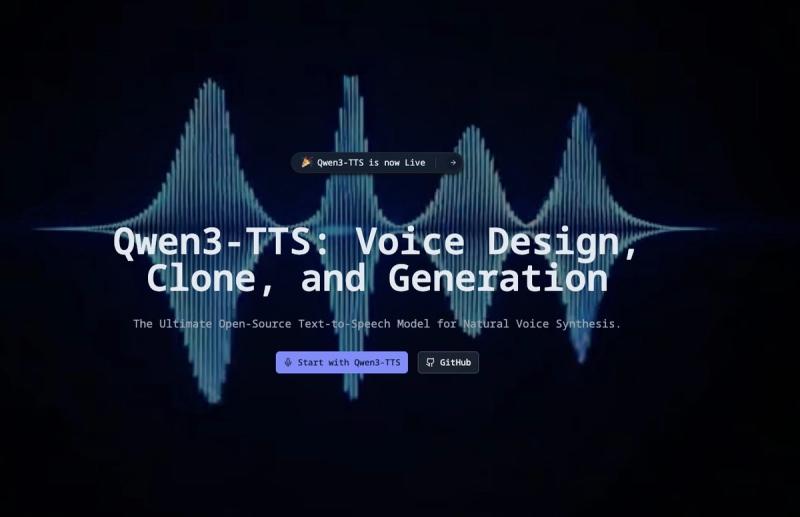
Qwen3-TTS is an open-source text-to-speech model that synthesizes natural human-like speech from text input, with support for zero-shot voice cloning, emotional control, and over 10 languages. It uses a proprietary 12Hz tokenizer and multi-codebook speech encoder to achieve a 97ms first-token latency, making it suitable for real-time applications. The model is released under the Apache 2.0 license, allowing modification and commercial use.
What is Qwen3-TTS?
Qwen3-TTS is an open-source text-to-speech synthesis platform developed by the Qwen team. It takes text input (up to 2000 characters in the web demo) and optionally a 3-second reference audio clip for cloning, and outputs synthesized speech audio. It runs on local hardware via a Python package or can be deployed as an OpenAI-compatible API server using a Docker image. The model’s core innovation is a high-efficiency 12Hz tokenizer that compresses speech signals into compact tokens while preserving paralinguistic features like breath, hesitation, and emotional intensity.
Key Features
- Zero-shot voice cloning — Clone a speaker’s voice from just a 3-second reference clip without any training or fine-tuning. The model captures timbre, accent, and style.
- Multilingual support — Natively supports over 10 languages including English, Chinese (Mandarin and dialects), Japanese, Korean, French, and German. Handles code-switching seamlessly.
- Context-aware prosody — Adjusts intonation, rhythm, and pacing based on the semantic context of the input text, distinguishing questions, exclamations, or somber tones.
- Real-time streaming — First token latency as low as 97 milliseconds, enabled by a dual-track generation architecture. Ideal for interactive voice bots and live translation.
- Long-form audio synthesis — Maintains consistency and natural flow over extended passages, suitable for audiobooks, podcasts, and narrations.
- Natural language audio control — Use text prompts to instruct the model to whisper, shout, laugh, or speak at a certain speed, giving fine-grained control over output style.
- Open-source license — Apache 2.0 license allows commercial use, modification, and redistribution without restrictive proprietary terms.
- Edge-to-cloud scalability — Lightweight enough to run on edge devices yet can be scaled via Docker for cloud deployment.
Who is it for?
- Developers building AI voice assistants or chat applications that require ultra-low latency and natural prosody. They can integrate Qwen3-TTS via the Python SDK or the OpenAI-compatible API.
- Content creators (podcasters, YouTubers, audiobook producers) who need to generate voiceovers with specific emotional tones or clone their own voice for consistent output across episodes.
- Startups and researchers looking for a customizable, cost-effective TTS solution to experiment with voice cloning, multilingual synthesis, or prosody control without paying per-character API fees.
- Localization teams who need to produce multilingual audio content with accurate pronunciation and code-switching support for global audiences.
What can you do with Qwen3-TTS?
- Voice cloning for personalized content: Provide a 3-second audio clip of any speaker, then generate unlimited speech in that voice. This can be used for dubbing video game characters or creating unique voice profiles for voice assistants.
- Real-time voice chat bots: Integrate the streaming API to power conversational agents that respond audibly within milliseconds, indistinguishable from a human interlocutor.
- Emotion-tuned narration: Instruct Qwen3-TTS to deliver a line with anger, sadness, or excitement by including a textual prompt (e.g., “speak with a happy tone”). This is useful for interactive stories or dynamic advertising.
- Long-form audio generation: Input entire chapters of a book or full podcast scripts; the model maintains consistent voice and prosody across the entire output without gaps or unnatural shifts.
How does Qwen3-TTS work?
- Installation: Install the Python package via pip (
pip install qwen3-tts). Ensure PyTorch is installed for GPU acceleration.
- Prepare input: Provide the text to synthesize. For voice cloning, also supply the path to a 3-second reference audio file. Optionally add a text prompt to guide emotion or style.
- Generate audio: Call the generation function for a single audio file or use the streaming API to receive audio chunks in real time.
- Deployment: Use the provided Docker image to launch an OpenAI-compatible API server, allowing Qwen3-TTS to replace existing TTS services in your infrastructure.
FAQ
Is Qwen3-TTS completely free for commercial use?
Yes, Qwen3-TTS is released under the Apache 2.0 license, which permits commercial use, modification, and distribution without royalties. You can integrate it into proprietary products.
What hardware do I need to run Qwen3-TTS locally?
The exact requirements are not listed, but since it uses PyTorch, a system with a CUDA-enabled GPU is recommended for real-time performance. CPU inference is possible but slower.
How does zero-shot voice cloning work?
The model analyzes the reference clip using its multi-codebook speech encoder, extracting speaker-specific features. It then applies these features while synthesizing the new text, preserving the original speaker's identity without fine-tuning.
The page does not mention SSML support. The primary control is via natural language text prompts (e.g., “whisper”) rather than SSML tags.
What languages does Qwen3-TTS support?
The model natively supports English, Chinese (Mandarin and dialects), Japanese, Korean, French, German, and more — over 10 languages in total. It handles code-switching within a single utterance.