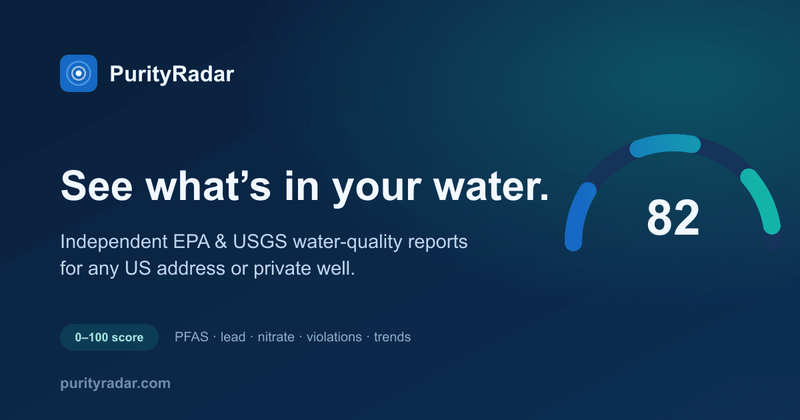
PurityRadar is a US water-quality lookup service that generates a personalized 0–100 safety score for any address or private well, with every figure linked to a public EPA or USGS source. It covers 20,612+ ZIP codes and tracks 47 contaminants across 76,283+ water systems.
What is PurityRadar?
PurityRadar takes a US address or private well location and returns a 0–100 personalized safety score, contaminant detections, historical trends, live advisories, and source citations. It uses EPA SDWIS, USGS, and utility records, is updated continuously, and runs entirely in the browser.
Key Features
- Historical trends — See how water quality has changed over years, not just a single snapshot.
- Private well coverage — Models area risk from USGS data; most other checkers ignore wells entirely.
- Live advisories — Boil-water alerts and water news for the exact area, with last-updated dates on every figure.
- Sourced data — Every figure links back to the EPA, USGS, or utility record with publication date and a named reviewer.
- Contaminant tracking — 47 contaminants; sample report shows PFAS at 6 ppt and trihalomethanes at 48 ppb, with lead, nitrate, arsenic rated low.
- City directory — Browse scores for 20+ major cities; e.g., Los Angeles and Chicago at 100, Philadelphia at 57.
- Plain-English blog — Guides on reading CCRs, choosing NSF-certified filters, and testing tap water.
Who should use PurityRadar?
- Homebuyers — Evaluate a prospective address’s water safety before closing, using the 0–100 score and contaminant report.
- Private well owners — Get modeled risk from USGS data, which most tools don't provide.
- Renters — Check tap water safety and current boil-water advisories for their exact location.
- Filter shoppers — Match a water filter to the specific contaminants in their report by reading the filter guide.
What can you do with PurityRadar?
- Movers: Get a safety score and contamination details for any street address they’re considering.
- Locals: Monitor the Water Pulse feed for boil-water or main-break advisories in their county.
- Parents: Look up PFAS, lead, nitrate, and arsenic levels in household drinking water and see how they've changed.
- Researchers: Rely on source-linked EPA/USGS records with named reviewers for citations.
How does PurityRadar work?
You enter an address or well location; the service produces a live 0–100 score with contaminant readings, historical trends, and local advisories. Every number links back to its EPA SDWIS, USGS, or utility record, complete with publication date and reviewer.
FAQ
What data sources does PurityRadar use?
PurityRadar uses EPA SDWIS, USGS groundwater data, and utility records. Each figure links back to its source with a publication date and named expert reviewer.
Does PurityRadar cover private wells?
Yes. For well addresses, it models risk from USGS data — an option most water-checking tools omit.
How often is data updated?
The site is updated continuously, and the sample report shows a date of Jun 12, 2026. Water Pulse advisories appear live.
Is PurityRadar free?
The page offers a free 28-page guide and a sample report, but it doesn't state pricing for full reports. A paid tier may exist, but that's not disclosed here.