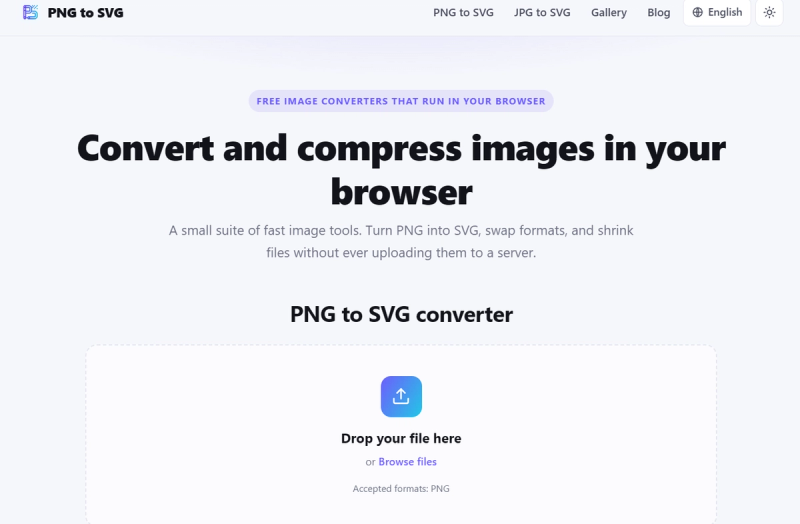
PNG to SVG is a free, browser-based image tool suite that converts PNG images to SVG and compresses images, with all processing done locally on the user's device. The site is built as a GitHub Pages project and offers a family of converters: PNG to SVG, JPG to SVG, JPG to PNG, WebP to PNG, plus dedicated SVG, PNG, and JPG compressors.
What is PNG to SVG?
PNG to SVG is a free web tool suite hosted on GitHub Pages. It takes PNG, JPG, JPEG, or WebP images as input and outputs SVG, PNG, or compressed files depending on the selected tool. The main converter offers two SVG output modes: vector trace, which redraws shapes as real vector paths, and raster embed, which embeds the original image without loss. Everything runs in the browser using standard web features, so no file is ever uploaded to a server.
Key Features
- Vector trace conversion — Converts PNG to SVG by tracing shapes into clean vector paths, ideal for logos, icons, and flat art.
- Raster embed mode — Embeds the original PNG into the SVG without any loss, preserving pixel data exactly.
- JPG to SVG converter — Accepts JPG and JPEG images and converts them to SVG for free.
- JPG to PNG converter — Converts JPG and JPEG images to PNG format for broader compatibility.
- WebP to PNG converter — Converts WebP images to PNG format for older software or simpler workflows.
- Built-in compressors — Separate SVG, PNG, and JPG compression tools reduce file sizes; the PNG to SVG result can be sent straight to the PNG compressor with one click.
- No upload or account — All conversion and compression happens locally in the browser, with no sign-up and no stated file limits.
Who is it for?
- Designers and developers — Convert PNG logos and icons to scalable SVG for web use without installing vector software.
- Web publishers — Compress SVG, PNG, or JPG images to speed up page loads while keeping files on their own device.
- Privacy-conscious users — Convert or compress private artwork without uploading it to a third-party server.
- Mobile users — Use the same tools on a phone browser to change formats or reduce file sizes on the go.
What can you do with it?
- Logo conversion — Turn a PNG logo into an SVG with vector trace mode for a sharp, scalable website header.
- Lossless embedding — Use raster embed mode to place a raster photo into an SVG wrapper without any quality loss.
- Format swapping — Switch between JPG, PNG, WebP, and SVG to meet platform requirements or shrink file size.
- Post-conversion compression — After converting PNG to SVG, click "Compress result" to run the built-in SVG compressor immediately.
How does it work?
- Drop a file — Drag an image onto the drop area or browse from your device; nothing is uploaded, so the file opens instantly.
- Choose the mode — For SVG, pick vector trace or raster embed; for compressors, set a quality level. Changes can be made as often as you like.
- Download and compress further — Save the result, or click "Compress result" to shrink it with one click if you want an even smaller file.
Pricing
All tools are free to use immediately, with no account, no sign-up, and no stated limits on the number of files converted.
FAQ
Do I need to create an account?
No. Every tool is free and open to use immediately, with no sign up and no limits on how many files you convert.
Are my images uploaded to a server?
Never. All conversion and compression happens locally in your browser, so your files stay on your device.
Which browsers are supported?
Any modern browser on desktop or mobile works, since the tools rely on standard web features rather than an installed app.
Is vector trace suitable for photos?
The site states that vector trace redraws shapes as real vector paths and is best for logos, icons, and flat art. For photos, raster embed mode preserves the original image without loss, so that is the mode to choose if you need a photo embedded in SVG.