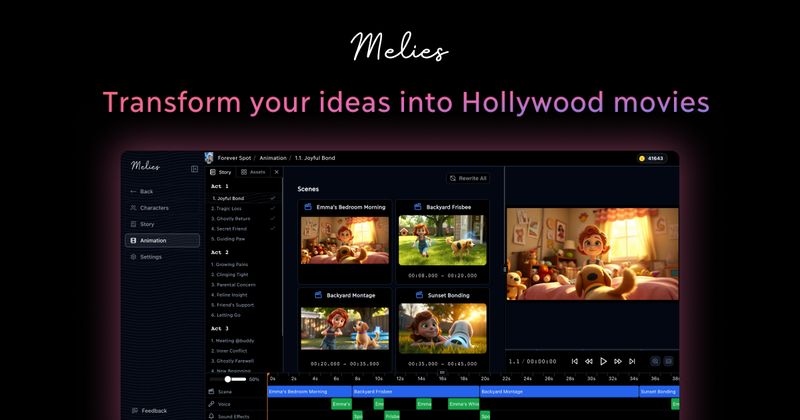
Melies is an all-in-one AI filmmaking platform that transforms ideas into professional-quality movies through a unified suite of AI-powered tools for story writing, character creation, video generation, music, and sound effects.
What is Melies?
Melies is a web-based AI studio that takes text prompts, reference images, or audio inputs and outputs cinematic videos, images, movie posters, and soundtracks. It integrates over 30 leading generative AI models—including Flux, Kling, Runway, Hailuo, and ElevenLabs—into a single workflow. The platform is developed by Melies (no parent company stated) and is accessible via browser with no installation required for the main tools, though it also offers a CLI tool for agent integration.
Key Features
150+ AI Actors — a diverse library of ready-to-use AI characters, plus the ability to train custom actors from a single reference photo, ensuring consistent faces across images, videos, and posters.
220+ Visual Styles — a curated library of art styles (anime, cinematic, cartoon, minimalist, surreal) that can be applied to any image with one click, searchable by category.
50+ AI Models — integrates models from Black Forest Labs (Flux), Kling, Runway, Luma Dream Machine, Hailuo AI, ByteDance (Seedance), LTX Video, Stability AI, Google (Gemini), OpenAI (GPT), Anthropic (Claude), ElevenLabs, Meta, xAI (Grok), and more.
AI Video Generator — transforms images and text into cinematic video clips up to 10 seconds, with camera movement presets and duration control, using models like Kling, Runway, Luma, and Hailuo.
AI Image Generator — generates stunning images from text prompts using the best available image models.
AI Movie Poster Generator — creates professional movie posters in any style.
AI Agent Creative Toolkit — a CLI tool (npm install -g melies) that allows AI coding agents (Claude Code, Cursor, Windsurf, GitHub Copilot, etc.) to generate images, videos, and more without manual prompt engineering.
Integrated audio generation — produces music, voices, and sound effects using ElevenLabs and other models.
Indie filmmakers who want to produce Hollywood-quality movies without big studio budgets, using AI to handle scripting, casting, visuals, and audio.
Content creators (YouTubers, social media influencers) who need to quickly generate consistent characters, scenes, and posters for their channels.
AI developers and agent users who want to integrate filmmaking capabilities into their coding workflow via the CLI and agent integrations.
What can you do with Melies?
Create a short film from scratch — write a story, generate consistent AI actors, produce scenes with varied expressions and camera angles, add music and sound effects, and export the final cut.
Design movie posters — select an actor, apply a visual style (e.g., Ghibli, noir), and generate a professional poster in seconds.
Generate cinematic video clips — upload a reference image, choose a model (Kling, Runway, etc.), set camera movement and duration, and produce up to 10 seconds of video.
Maintain character consistency — upload a photo of a person or use a pre-built actor, and use that same face across all images, videos, and posters without retraining.
How does Melies work?
Users start by choosing a tool (Image Generator, Video Generator, Poster Generator) or using the CLI. They input a text prompt or upload a reference image, select an AI actor and visual style if desired, then generate. For video, they can adjust camera movement and duration. The platform handles model selection automatically but allows manual override via the compare page. The CLI tool (npm install -g melies) enables agent-driven creation with commands like melies image "portrait in a café" --actor mei --art-style ghibli --lighting golden.
Pros and cons
Pros: All-in-one platform with broad model integration; consistent character support; large library of pre-built actors and styles; CLI for developers; commercial use allowed (as stated in FAQ).
Cons: The free tier may have usage limits or watermarks (not specified on page); some features require a subscription; learning curve for the CLI.
Pricing
Melies operates on a freemium model with paid plans. The site does not list specific prices, but users can create an account and start creating with a free tier; paid plans unlock higher usage limits and premium features.
Alternatives
Runway — focuses on video generation with a different model set and may lack the all-in-one character consistency of Melies.
Pika — another AI video platform that emphasizes motion and editing, but offers fewer pre-built actors and style libraries.
KREA — similar image/video generation but without the dedicated filmmaking workflow and agent integration.
FAQ
What is Melies?
Melies is an all-in-one AI filmmaking platform that lets users write stories, generate images, create videos, add voices, music, and sound effects. It provides a complete toolset for turning ideas into finished movies.
What AI models does Melies use?
Melies integrates over 30 models including Flux, Kling, Runway, Luma Dream Machine, Hailuo AI, Seedance, LTX Video, Stability AI, Google Gemini, OpenAI GPT, Anthropic Claude, ElevenLabs, Meta, and xAI Grok. Users can compare and choose models.
Is Melies free to use?
Melies offers a free tier with limited usage. For higher quotas, faster generation, and premium features, users need to subscribe to a paid plan (pricing details on the pricing page).
Can I use AI-generated content commercially?
Yes, Melies allows commercial use of content created on the platform, subject to the model providers' terms (which are generally permissive). Check the specific model terms for certainty.
How is Melies different from Runway, Pika, or KREA?
Melies is uniquely designed for filmmaking from story to final cut, with dedicated actor consistency, a library of 150+ AI actors, 220+ visual styles, an integrated CLI for agents, and a unified workflow across image, video, poster, and audio generation.
What can I create with Melies?
You can create short films, movie posters, cinematic video clips, consistent character images, and full audio scores. The platform supports output in common formats appropriate for each media type (images: PNG/JPEG, videos: MP4, etc.).