
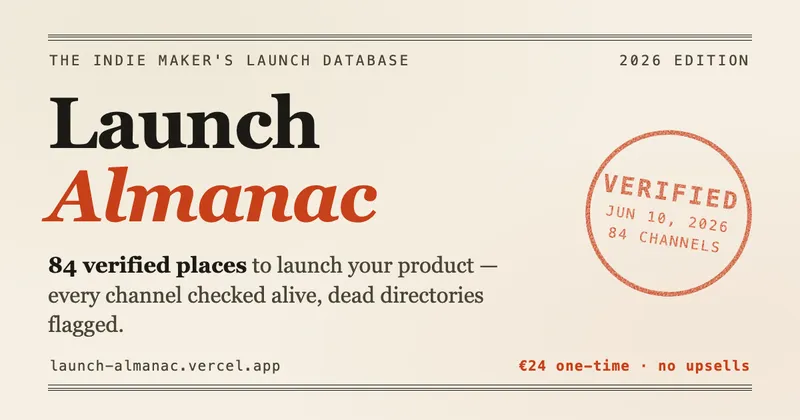
Launch Almanac is a verified database of 84 product-launch channels for indie makers, combining costs, audience data, submission requirements, ready-to-paste templates, and a Claude Skill that automates the submission process.
What is Launch Almanac?
Launch Almanac is a one-time-purchase digital kit that solves the time-sink of launch research. The problem it addresses: launch research eats about 40 hours, and many free directory lists contain dead links. The kit contains a live-verified list of 84 launch channels — directories, communities, newsletters, review sites, and AI engines — each checked alive on June 10, 2026, with costs, expected value, and requirements. You provide your product's details once; the kit outputs submission-ready copy, a tracking sheet, and a Claude Skill workflow to submit across channels. It is delivered as CSV + Markdown files plus a Claude Skill folder, so it runs on any device that can open those formats.
What makes Launch Almanac stand out?
Its defining difference is verification: every channel carries a live-check date and dead directories are flagged, while free lists leave you to discover them by wasting submissions.
- Verified freshness — Every channel was live-fetched on June 10, 2026; 7 dead directories (e.g., BetaPage absorbed by PitchWall, Supertools absorbed by rundown.ai) are explicitly flagged, so you don't waste submissions on redirects.
- 84-channel database — Includes launch platforms, tool directories, review sites, newsletters, and communities, with submission URL, cost, audience estimate, domain authority hints, and expected value per channel.
- Ready-to-paste templates — Taglines, short and long descriptions, and maker comments pre-written for each channel type; no rewriting your pitch 84 times.
- launch-submitter Claude Skill — An agent workflow for Claude Code or Claude.ai that walks the database, fills submission forms with your product details, and tracks what's done.
- GEO/AI-visibility checklist — 10 concrete steps to get your product cited by ChatGPT, Claude, and Perplexity, including which listing types feed the models.
- Launch tracking sheet — A pre-built sheet to log status, queue dates, backlinks earned, and referral traffic for every submission.
- 12 months of updates — Re-verified editions of the database included; every row carries its verification date so freshness is always known.
Who is Launch Almanac for?
It's for anyone shipping a software product — SaaS, app, dev tool, AI tool, or open-source project — who wants a faster, more reliable launch.
- Indie SaaS founders — Launch a new tool to 84 channels without spending 40 hours on research; use the tracking sheet to manage queue times and follow-ups.
- AI tool developers — Use the GEO checklist and AI-focused listings like PeerPush to get cited by ChatGPT and Perplexity.
- Open-source maintainers — Find free directories and communities friendly to open-source projects, with submission requirements spelled out.
- Non-Claude users — The database, templates, checklist, and tracking sheet are plain files that work without Claude; only the automation Skill requires Claude.
What can you do with Launch Almanac?
You can plan, automate, and track a full launch across 84 channels without manual research.
- Speed up launch distribution: Instead of researching each directory, you have all 84 channels with costs and requirements in one CSV, so you can pick targets in minutes.
- Automate submissions: The Claude Skill fills forms with your product details and tracks status, turning a multi-week manual chore into an automated round.
- Avoid dead endpoints: The 7 flagged dead directories (BetaPage, Supertools, and friends) are removed from the active list, so you don't lose a submission to a redirect.
- Get cited by AI engines: The GEO checklist and directories like AlternativeTo and PeerPush are chosen specifically to feed ChatGPT, Claude, and Perplexity citations.
How does Launch Almanac work?
After purchase, you download a kit containing the channel database as CSV and Markdown, submission templates, the Claude Skill folder, the GEO checklist, and the tracking sheet. You fill in your product details once; the templates generate taglines and descriptions. If you use Claude, the launch-submitter Skill reads the database row by row, drafts the submission, and marks each channel as done in the tracking sheet. The Almanac is re-verified monthly for 12 months, and updated editions are sent to you.
How much does Launch Almanac cost?
Launch Almanac costs €24 as a one-time payment, with no subscription. That includes the database, templates, Claude Skill, GEO checklist, and tracking sheet, plus 12 months of database updates. The page contrasts this with done-for-you services at $99–349 and 40–80 hours of manual work, and offers a 14-day refund.
FAQ
Are the free directory lists enough?
Free lists give stale URLs; Launch Almanac's value is verification. Every channel was live-checked on June 10, 2026, and 7 dead ones are flagged, so you're not submitting to redirects.
What exactly do I download?
A kit: the channel database (CSV + Markdown), submission templates per channel type, the launch-submitter Claude Skill folder, the GEO checklist, and the tracking sheet. Database updates are included for 12 months.
Do I need Claude to use this?
No. The database, templates, checklist, and tracking sheet are plain files usable with any editor. The automation Skill is a bonus for Claude Code or Claude.ai users; without Claude, everything else works manually.
What is GEO and why should I care?
GEO stands for Generative Engine Optimization — getting your product cited when people ask ChatGPT, Claude, or Perplexity for recommendations. The Almanac's GEO checklist and its inclusion of AI-visible directories like AlternativeTo help you feed those engines.
Will this work for my product?
The database covers general launch platforms, dev tools, AI tools, SaaS review sites, open-source directories, newsletters, and communities. It's for software products; the page explicitly says physical goods are not a fit.
Pros and cons
The trade-offs are straightforward.
- Pros: Verified data (every channel checked on June 10, 2026), includes 7 dead flags, templates save time, Claude Skill automates submissions, 12 months of updates, one-time price.
- Cons: The automation Skill requires Claude (Claude Code or Claude.ai), and the database covers software products only — physical goods are explicitly out of scope.


