Newsletter
Join the Community
Subscribe to our newsletter for the latest news and updates
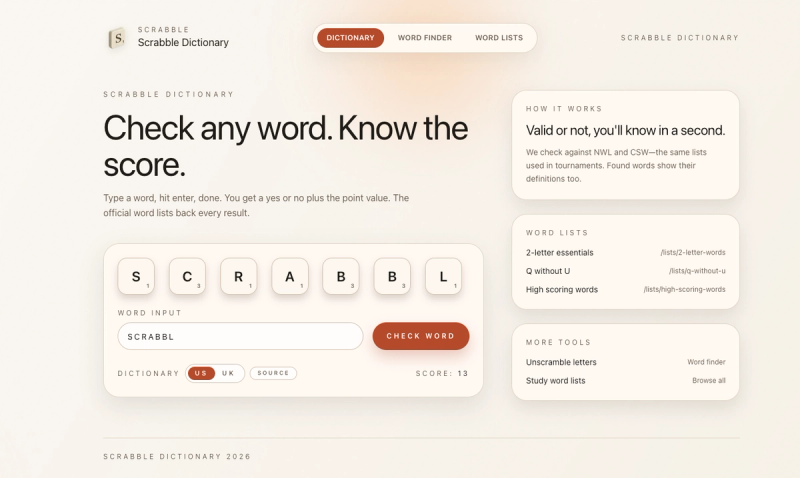
Scrabble dictionary and word-finder that validates words against official lists on the server and adds cached definitions for quick lookups.
Traffic, search & AI signals for scrabble-dictionary.com.
Third-party traffic estimate · Updated Sep 9, 2026
Submit your own product to reach creators and founders looking for the next tool to try.
Scrabble Dictionary is a web-based word validation and lookup tool that uses the official NWL (North American) and CSW (International) tournament word lists to confirm whether a word is valid in Scrabble. It also serves as a word finder, taking a rack of letters (including blanks represented by "?") and returning all valid plays. Built by the Scrabble community and hosted at scrabbleplayers.org, it provides instant yes-or-no validation, point values, definitions, and anagrams.
The Scrabble Dictionary is an online tool that checks if a word is valid according to the official word lists used in Scrabble tournaments: NWL2023 (for North America) and CSW (for international play). Users input a word or a rack of letters, and the tool outputs whether the word is valid, its Scrabble point score (e.g., "SCRABBLE" scores 13), and optionally a definition. The word finder accepts blanks and returns all possible words from a given rack. The site is maintained by the North American Scrabble Players Association (NASPA) and Collins.
Yes. It uses the same NWL and CSW word lists used in Scrabble tournaments worldwide, so every validation is authoritative.
Each letter has a fixed point value (A=1, B=3, Q=10, Z=10, etc.). The tool sums these values to produce the base score for the word (no premium squares included).
Yes. While Words with Friends uses a slightly different dictionary, most Scrabble-valid words are also valid there. The tool's word finder works for both games.
NWL is the official list for North American tournaments; CSW is used internationally and contains more words, including many British English terms.
It uses the latest official lists (NWL2023 and CSW) validated directly against tournament sources, ensuring tournament-level accuracy.