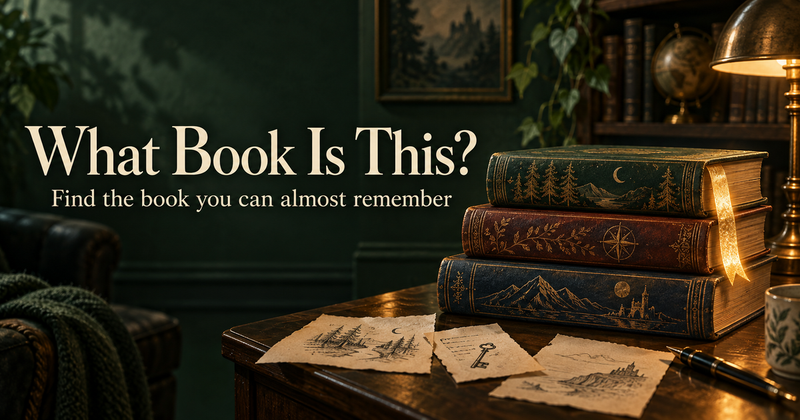
What Book Is This is a web-based AI book finder that converts the fragments of a story you still remember — a plot point, a character, a setting, a half-remembered quote, or a cover detail — into a shortlist of candidate titles, each paired with a note explaining which of your clues it matched. It runs in the browser at whatbookisthis.com, and searches start from a single free-text description box.
What is What Book Is This?
What Book Is This is an AI-powered book identification tool that takes a free-text description of a story you cannot name and returns several likely book titles instead of one fixed answer. You type in whatever you remember — plot, characters, setting, a quote, or the physical cover — and the finder compares those clues against catalogued book details, then attaches a "Why it fits" explanation to each match so you can recognise the right title yourself. The site also hosts dedicated clue pages for finding a book by description, by plot, and by quote, plus a blog of reading guides. No maker or company name is stated on the page.
What makes What Book Is This stand out?
- Clue-level matching — the finder compares your description against plot, setting, characters, quotes, and cover details rather than a single keyword field.
- Explained matches, not just titles — every suggestion ships with a "Why it fits" line, e.g. Nineteen Eighty-Four for "a man under constant surveillance, afraid to write down what he thinks" because surveillance and the danger of a diary are central to Winston's life in Oceania.
- Built for uncertain memory — the page explicitly tells you to include details even when you are not fully sure of them, and to start with the one clue you trust most.
- Three dedicated clue routes — separate entry points for finding a book by description, by plot, and by quote, for users who only remember one type of fragment.
- Structured clue guidance — prompts for plot shape (what happened first, what changed, how much of the ending you recall), time and place (a school, a lighthouse, 1980s New York, a future colony), and the physical book (hardback or paperback, cover colour, illustrations, language, when you read it).
- Multiple candidate answers — the tool returns a shortlist to check rather than forcing a single guess.
- Reader examples on the page — anonymized descriptions are shown resolving to Piranesi, The Night Circus, and The Giver.
- Companion guides — blog posts on checking a half-remembered quote against its source and edition, and on reading the edition clues behind a book cover.
Who should use What Book Is This?
- Readers with a forgotten title: anyone who remembers a scene, a character, or a green light across the water but not the author, and needs candidate titles to check.
- Quote-hunters: people who recall a line or a phrase from a book and want to trace it back to the source and its context.
- Book-club and gift shoppers: users who can describe the plot shape of a book someone else mentioned and want a shortlist of titles to verify before buying.
- Fans returning after decades: readers who remember the physical object — hardback or paperback, cover colour, illustrations, the language they read it in — and want that format detail used as a filter.
What can you do with What Book Is This?
- Recover a half-remembered novel: describe the plot's beginning, turning point, and the part of the ending you recall, and get a set of titles with the matching clues spelled out.
- Verify a remembered quote: paste the line you think you remember into the quote route and use the result to check the book and the context it appears in.
- Narrow a shelf by setting: supply time and place details such as a 1980s New York or a future colony to cut the number of candidate books you have to review.
- Match on the physical edition: add cover colour, illustrations, or language to distinguish between editions of books with similar plots.
How does What Book Is This work?
The finder runs in three stated steps. You first describe what you remember — plot, character, setting, a quote, or the cover — then the AI compares those clues against books sharing the same details, and finally you open the likely matches and use each explanation to recognise the right book. The page notes that adding more detail produces fewer, more useful matches.
Alternatives
- Reddit's r/whatsthatbook — a human community where readers post remembered details and other users guess the title, rather than an AI comparison.
- Goodreads' "What's the Name of That Book?" group — a forum-based version of the same crowdsourced identification approach.
FAQ
What details should I include to find a book?
A plot point, character, setting, cover detail, approximate year, genre, or a quote can all help, and the page advises including details even when you are not fully sure of them. Setting clues such as a school, lighthouse, or decade narrow results fastest.
Can I find a book from a description only?
Yes — the finder accepts a plain-language description of a scene, character, or cover, and one useful clue is enough to start; you can add more as they come back to you. It returns candidate titles with explanations rather than a guaranteed single answer.
Can it identify a book from a half-remembered quote?
The site provides a dedicated find-a-book-by-quote route: you start with a half-remembered line and the finder traces it back to its book and context. A companion blog guide explains how to test a remembered line against its source and edition.
Why do I see more than one possible book?
Because a single remembered detail — a circus at night, a boy who starts seeing colour — can fit several books, the finder returns a shortlist instead of one title. Each result includes a "Why it fits" explanation so you can open the candidates and pick the match yourself.