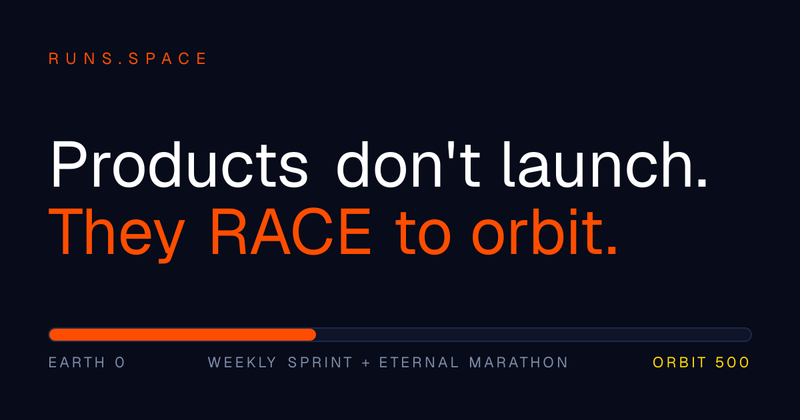
runs.space is a browser-based launch race platform where makers submit a product as a rocket, collect fuel from other users, and race from Earth to Orbit at 500 fuel.
What is runs.space?
runs.space turns a product launch into a race on a public live track. A maker submits a project through the launch form and receives a rocket that occupies a numbered pad in that week's grid; other users then spend fuel to push it through four stages — Earth at 0, Stratos at 100, Low Orbit at 250 and Orbit at 500 fuel. The output is a running leaderboard position, a weekly Sprint prize pool and a permanent record of the race under week-numbered URLs. Everything runs in the browser, and the contact address on the page ([email protected]) points to the team behind sublimearts.io.
What makes runs.space stand out?
- Two races running at once — every rocket competes in the Sprint (most fuel raised this week, which takes the prize pool) and the Marathon (a personal climb to 500 fuel that ends in a permanent Hall of Fame satellite), so no entry is ever eliminated.
- A capped weekly grid — each race opens only 20 to 30 pads, a limit the page describes as "scarcity = signal," with Genesis race #01 seeded by 20 hand-picked projects.
- Per-person fuel limits — one fuel per person per rocket per week and no self-fuel, plus a Super Fuel worth 5× that Runner-tier users can hand to one ally each week.
- Live track and mission feed — a realtime board shows each rocket's fuel count, rank and stage, next to a feed of timestamped events such as launches and fuel gifts.
- 20 reserved, claimable pads — pads are pre-held for named projects including Alpine.js, BetaList, BuildHop, DevHunt, Espanso, HeadshotPro, Kabza, Obsidian, OpenSource UI, PageGains, PDF.ai, Photopea, Remote OK, Rootd, SaaS Pegasus, ShipFast, Sidekiq, SUDARI, VoxelWall and Zod, all listed from public information and claimable by their owners.
- A permanent flight log — past races stay online at week-addressable pages such as 2026-W38, 2026-W37 and 2026-W36.
- Hangar Pass — a separate option for makers who want the permanent project page without entering the weekly race, and a sponsor slot is openly offered.
Who should use runs.space?
- Indie makers shipping a new tool who want a time-boxed weekly contest and a shareable race URL rather than a static directory listing.
- Developers whose earlier Product Hunt launch got buried — the first Genesis race's 20 pads were drawn from exactly that group, and unclaimed pads remain open.
- Community voters who publish nothing — a Walker account can give 3 fuel per day to other people's rockets and influence which project takes the Sprint.
- Owners of the pre-listed projects (Zod, Obsidian, PDF.ai, Photopea and others) who can claim their reserved pad and enter the race.
What can you do with runs.space?
- Solo maker launching a product: submit a rocket, share its race link, and collect fuel from visitors to climb toward Orbit and a slice of that week's prize pool.
- Small team buying a Runner entry: fund the pool while gaining 10 fuel per day and one 5× Super Fuel per week to boost an ally's rocket.
- Community supporter with a free Walker account: send up to 3 fuel per day across other rockets and help decide the weekly Sprint winner.
- Owner of a reserved project: claim a pre-listed pad and turn a placeholder into a live racing entry.
How does runs.space work?
- Launch — submit your project and receive a rocket; the weekly grid is capped at 20 to 30 pads.
- Fuel — anyone can add fuel, at one fuel per person per rocket per week, with no self-fueling and Super Fuel counting as 5×.
- Orbit — the Sprint awards the week's most-fueled rocket, while the Marathon tracks a personal climb to 500 fuel and a permanent Hall of Fame satellite.
Exact eligibility, tie-breaking and prize terms are covered on the site's full rules page.
Pricing
Walker is the free tier: unlimited rockets, 3 fuel per day to give away, full prize eligibility, no card required. Runner is paid at $19 per race or $39 per month and lasts 7 days, granting 10 fuel per day, one 5× Super Fuel per week and no cap that could block a launch. The prize pool equals 50% of Runner entries, so a full grid of 20 Runners makes it $380, with $190 to the winner. A separate Hangar Pass covers a permanent page without racing.
FAQ
Is runs.space free?
Walker is free forever and needs no card: you can launch as many rockets as you want and give 3 fuel per day to other rockets, and every racing rocket is eligible for the prize pool. Runner is the paid tier at $19 per race or $39 per month.
What is fuel and how much is needed to reach Orbit?
Fuel is the race's support unit, capped at one fuel per person per rocket per week, with no self-fueling and a 5× Super Fuel. Rockets pass Earth at 0, Stratos at 100, Low Orbit at 250 and Orbit at 500 fuel — 500 being both Orbit and the personal Marathon goal.
How many projects can join each race?
Each weekly race opens 20 to 30 pads. Genesis race #01 currently lists 20 reserved pads, occupied by projects held from public information that are not racing and collecting no fuel until their owners claim them.
Do rockets get eliminated if they lose?
No. Nothing dies on runs.space — the Sprint rewards the most fuel raised in a given week, while the Marathon is a personal climb to 500 fuel with a permanent Hall of Fame satellite as the payoff. Finished races stay in the flight log at week URLs like 2026-W37.
How do I get a reserved pad for my project?
Twenty pads for named projects such as Obsidian, Zod, Sidekiq, ShipFast and Photopea are held on the basis of public information. Each reserved pad has a claim link that asserts ownership; if your project is not among them, you can start a fresh rocket from the launch page instead.