JevCases is a community case wall that indexes 42 open-source projects and demos which use Jev, a judgment layer that lets an AI agent select a typed decision — an operation, a component, a next action — from a bounded set of options. Visitors search, filter, and sort the wall in a browser, then open an individual case page for its check date, project context, and upstream source.
What is JevCases?
JevCases is a web directory and showcase for community projects built around Jev, a decision layer that sits inside agents and picks among typed candidates. From the main page you can search the case wall, filter by category, or sort by most stars, name A–Z, or original order, and each result is a card showing a case number, category, screenshot preview, GitHub owner handle, star count, a one-line description, and a link to the full case. The site also publishes live demos and links out to the underlying repositories rather than hosting them.
What makes JevCases stand out?
- 32 case categories — the filter list spans agent context, agent guardrails, AI trading, browser agent, browser extension, code review, codebase navigation, codex routing, completion checks, data curation, data import, data warehouse, decision recipes, desktop automation, document classification, email classification, emulator agents, game agent, generative UI, graph navigation, idea evaluation, incident triage, liquidity agent, log analysis, market making, mobile agent, model context protocol, semantic search, shell pipelines, simulation, skill routing, and video analysis.
- Dated star snapshots — listed GitHub star counts are drawn from snapshots dated 2026-09-25 through 2026-09-27, and each case page states its own check date, project context, and source.
- Search, filter, and sort controls — a search field plus an all-categories dropdown and three sort orders (Most stars, Name A–Z, Original order) sit above the 42 matching cases.
- Popularity visible at a glance — entries range from @browser-use at 19,822 stars and @vercel-labs json-render at 18,257 down to newer projects at 0, so the wall doubles as a rough popularity ranking.
- Judgment-style framing per case — descriptions name the specific decision Jev makes, such as classifying market conditions in Prism, choosing outgoing relationships in neo4jev, or selecting model tiers in jev-router.
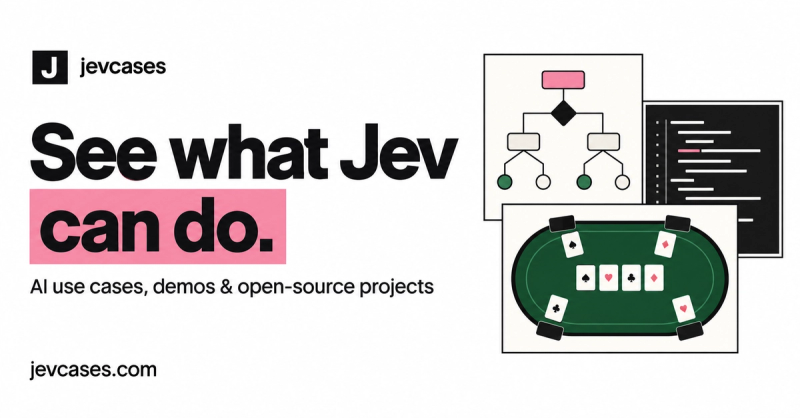
- Live demos section — a separate block lists 2 available demos: Texas Hold'em, a six-seat decision table, and Jev Live Poker, a six-seat automatic broadcast table with risk profiles running from conservative to aggressive.
- Labeled sponsor slots — advertising placements are marked as clearly labeled, separate from cases, at $20 per 30 days.
Who should use JevCases?
- Agent and tooling developers: survey prior art in a specific slot — browser agents, MCP servers, code review, context compaction — before building their own integration.
- Teams adding guardrails or routing: read how projects like pi-warden, Canny, and jev-skill-router keep deterministic code in control while Jev supplies judgment.
- Data and trading engineers: find cases such as Jevflake (Snowflake SQL and dbt), jev-curate (JSONL and Parquet records), or Prism and QuantDinger for market-facing decisions.
- Curious observers: watch the two live poker demos to see decisions displayed seat by seat.
What can you do with JevCases?
- Vet a category before committing: filter the wall to a single category such as model context protocol or semantic search and compare the star counts, owner handles, and one-line summaries of every matching case.
- Trace a project to its source: open any case to read its check date, context, and links, then follow through to the GitHub repository behind it.
- Study how a single decision is typed: use cases like killmyidea (KILL, FIX, or SHIP verdicts) or sys1grep (proposition checks combined with AND, OR, and NOT) to see how outputs are constrained.
- Find something to watch rather than read: open the Texas Hold'em or Jev Live Poker demo to see a decision table play out in the browser.
FAQ
How many cases does JevCases list?
The case wall shows 42 matching cases, with a section labelled "more cases in progress." Each entry carries a case number, a category label, a preview image, the GitHub owner handle, a current star count, and a one-line description of the judgment the project delegates to Jev.
Is JevCases free to use?
Browsing, searching, and filtering the case wall is free and needs no account. The only stated price on the page is the labeled advertising slot, offered as a clearly separated placement for AI teams at $20 per 30 days.
How current are the star counts?
Star counts are GitHub snapshots taken between 2026-09-25 and 2026-09-27, so they are point-in-time figures rather than live numbers. Opening an individual case shows that project's own check date, context, and source link.
Does JevCases host the projects it lists?
No. JevCases presents short case write-ups and previews, and each card links out to a full case page that points back to the original repository or project. Only the two poker demos run on the site itself, described as a local demo and a live table.
What kinds of projects appear most often?
Agent infrastructure dominates: browser agents, agent context handling, model context protocol servers, skill routing, and completion checks appear repeatedly, alongside vertical uses such as email classification, log analysis, emulator agents, and simulation work like the MuJoCo-based jev-drone case.