
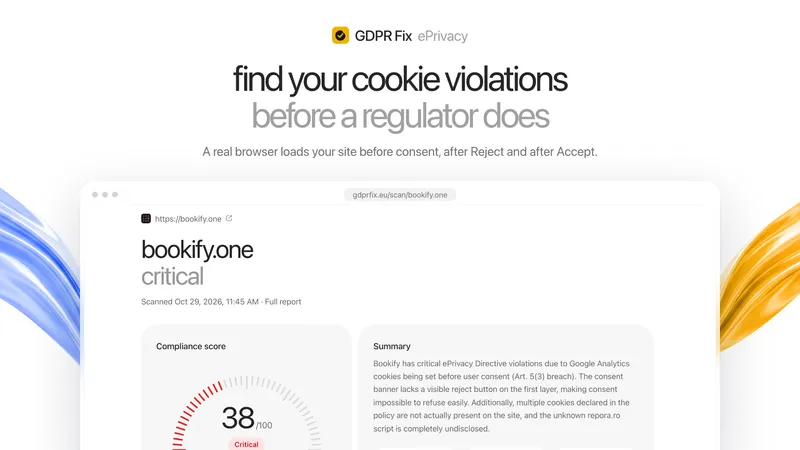
GDPR Fix is a cookie-compliance scanner that loads a website in a headless browser and reports every cookie, tracker and consent-banner problem against the ePrivacy Directive and GDPR, with a fix attached to each finding.
What is GDPR Fix?
GDPR Fix takes a single input — your site's URL — and returns a law-mapped compliance report: a 0–100 score, issues grouped by severity, the cookies actually set at each consent stage, a consent-banner audit and a policy checklist. The web app is built by Eduard Pantazi, signs you in with Google or a one-time email link, and requires no tag, plugin or script on your site. Scans complete in roughly two minutes.
What makes GDPR Fix stand out?
- Real browser scanning, not static parsing — Playwright visits your site three times: once before consent, once after clicking accept, once after clicking reject, and captures the cookies set at each stage.
- Findings mapped to specific law — issues are tied to ePrivacy Art. 5(3) (cookies before consent), EDPB 03/2022 (reject as easy as accept), GDPR Art. 13 (every cookie named in the policy) and GDPR Art. 28 (processors disclosed).
- Named cookie detection — the report identifies first- and third-party cookies such as
_ga(Google Analytics),_fbp(Meta Pixel),_gcl_au(Google Ads),_hjSession(Hotjar) andcf_clearance(Cloudflare, necessary). - Severity scoring — the 0–100 score is banded Critical (0–49), Needs work (50–69) and Good (70+), and a sample masked scan of a real site returned 8 issues across overview and fix tabs.
- MCP server for AI coding tools — every full report exposes an MCP endpoint (
https://gdprfix.eu/api/mcp) with bearer-token auth that plugs into Claude Code, Cursor, VS Code or Claude Desktop; the AI reads the report, edits files such as your layout or cookie banner, then re-scans to verify. - AI cookie-policy generator — produces a cookie policy from the cookies and services actually detected, including cookie tables, third-party disclosures, user rights and withdrawal instructions.
- Copy to LLM — copies a structured prompt with the issue details and fix instructions for pasting into Claude, ChatGPT or Cursor.
- No install footprint — zero scripts are added to your site, unlike consent management platforms that inject a banner.
Who should use GDPR Fix?
- Web developers and small agencies auditing a client site before launch, using the MCP server to patch tracking scripts in the codebase and re-scan.
- SaaS and e-commerce founders who added Google Analytics, Meta Pixel or Hotjar via a tag manager and never updated the privacy policy.
- Freelancers maintaining several sites who need a per-site report without a monthly subscription — credits are bought one at a time and never expire.
- Anyone who received a complaint and needs to know which cookies fire before consent and which disclosures are missing from the policy.
What can you do with GDPR Fix?
- Front-end developer: connect Claude Code over MCP, ask it to fix issues on a domain, and watch it edit the layout to load Google Analytics only after consent and add a "Reject all" button to the first banner layer.
- Agency auditor: run a free scan per prospect, then unlock the full report to get the PDF and the detailed fix list for each critical issue.
- Site owner without a developer: use the AI cookie-policy generator to replace a policy that says "no analytics, no tracking" while GA4 runs through Google Tag Manager.
How does GDPR Fix work?
You paste a URL after signing in, and the scanner loads the site in a real browser before and after consent. The output lists cookies set before consent, per-service trackers, a consent-banner audit (banner present, blocks cookies, reject on first layer, reject as easy as accept) and a policy checklist. You then fix each issue yourself, hand it to an AI tool over MCP, or copy the prompt to an LLM.
Pricing
GDPR Fix uses a pay-per-scan credit model rather than a subscription. The free tier includes one scan with a compliance score, issues by severity and the cookie and consent breakdown at €0. A single detailed report is €3, and a 10-scan pack is €8 (discounted from €10, €0.80 per scan) with the AI cookie-policy generator and downloadable PDF reports. Payments run through Creem, credits never expire, and refunds are offered within 7 days.
Alternatives
Cookiebot, OneTrust, CookieYes.
FAQ
Do I need an account to scan?
Yes. GDPR Fix requires sign-in with Google or a one-time email link so results are saved to your account. The free tier includes one scan; additional full reports are bought as credits, and the sample session in the docs notes when a free scan has been used up.
How accurate is the scan compared with a manual audit?
The scanner uses a real headless browser (Playwright) rather than parsing HTML, so it sees cookies that JavaScript sets at runtime. It captures cookies before consent, after accept and after reject, detects the banner, and pulls the live privacy policy for comparison.
Does GDPR Fix install a cookie banner on my site?
No. It is an audit tool, not a consent management platform — zero scripts are added to your site. It tells you whether your existing banner blocks cookies, offers reject on the first layer and avoids dark patterns, and how to fix it in your own code.
What is the MCP server for?
Every full report ships with an MCP endpoint that Claude Code, Cursor, VS Code or Claude Desktop can connect to in about a minute. The AI reads your report, edits your codebase, and can start a new scan to confirm the score improved; it asks before spending a scan and only sees your own reports.
Which cookies does it recognise?
The detector identifies common first- and third-party cookies and their category, including Google Analytics (_ga), Meta Pixel (_fbp), Google Ads (_gcl_au), Hotjar (_hjSession) and Cloudflare's necessary cf_clearance, and flags any that are set before consent or missing from your policy.


