
"Just ask ChatGPT" has quietly become a discovery channel — somewhere between a search engine and a friend's recommendation. If an AI assistant suggests your product by name when someone asks "what's a good tool for X," that's a visitor you didn't have to win through ads or SEO rankings. The question is how many indie products are actually capturing that channel today, and whether it's worth building for.
We pulled Similarweb's AI-referral breakdown for every product in Turbo0's indie pool — 3,295 listings with usable traffic data, capped at 5,000,000 monthly visits so giants like ChatGPT itself don't skew the picture. Of those, 164 products (4.98%) show any measurable traffic from an AI platform — ChatGPT, Gemini, Claude, Perplexity, Copilot, DeepSeek, or Grok. This article is built entirely on that 164-product dataset, cross-referenced against our separate high-growth dataset (333 products growing 20%+ month-over-month) to see whether AI traffic and growth actually move together.
TL;DR:
- AI referral traffic is real but still tiny — only about 5% of measurable indie products get any of it, and for most of those it's under 1% of total visits.
- ChatGPT is the AI discovery channel that matters right now. It appears in 144 of 164 products (87.8%) and supplies an average of 65.5% of whatever AI traffic a product gets — Gemini, Claude, and Perplexity are present but each control a smaller slice.
- Products that already get AI traffic are roughly twice as likely to also be in high-growth territory (20.1% vs. 9.5% for products with no AI traffic) — though we can't say which one is causing the other.
How small is the window, really?
Before looking at winners, it's worth being honest about the size of the opportunity. Even among the 164 products that show up in an AI assistant's answers at all, most of them barely register.
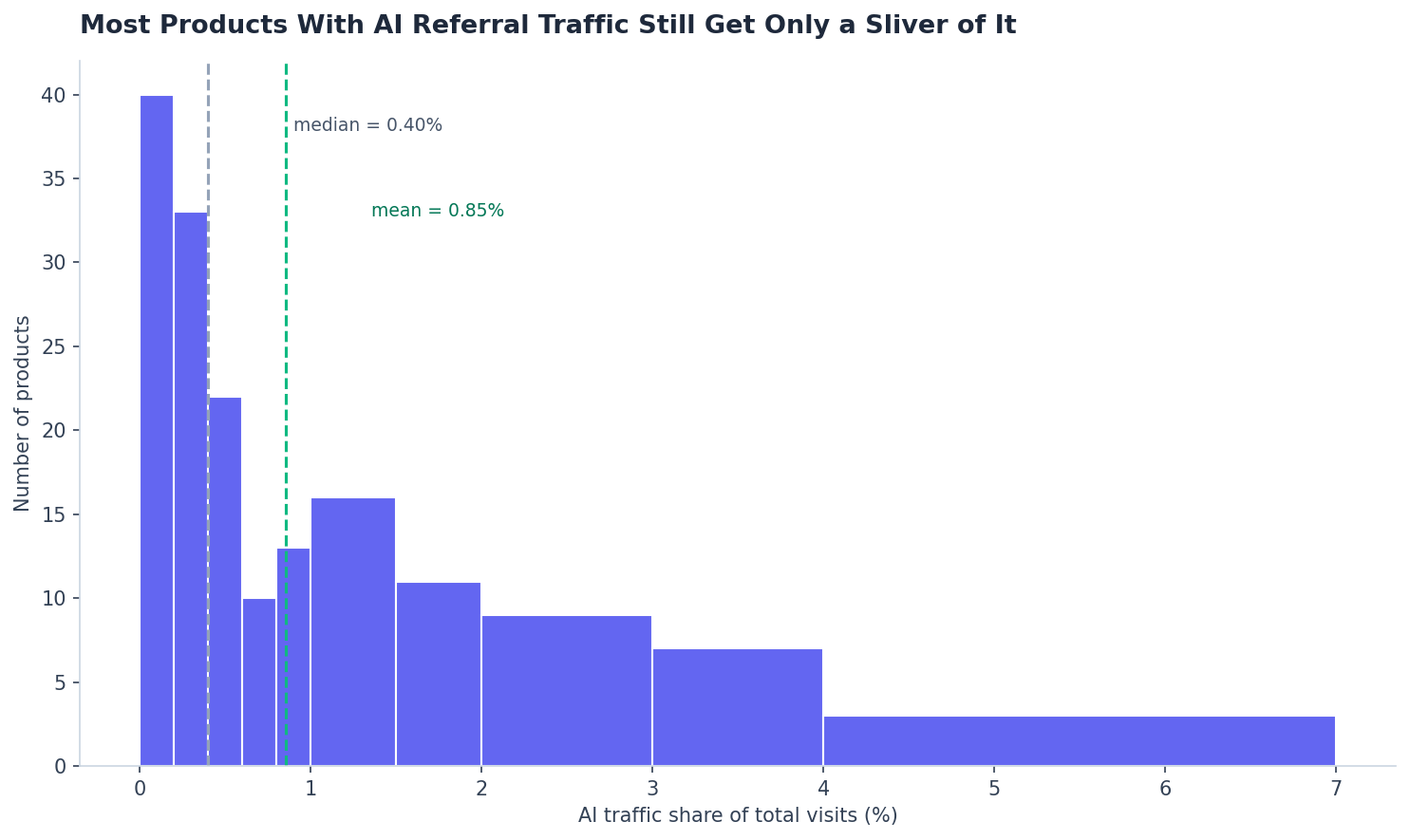 Distribution of AI traffic share among the 164 products that have any. Half of them sit below 0.4% of total visits; only a handful cross 3%.
The median product in this dataset gets 0.4% of its total traffic from AI assistants; the mean is pulled up to 0.85% by a short tail of outliers. Only 10% of the 164 products cross 2.17%, and the single highest share in the entire indie pool is 6.3% (HandBrake, more on that below). Compare that to search or direct traffic, which for most of these same products still make up the overwhelming majority of visits.
So the honest framing is: AI referral traffic is not yet a primary channel for anyone in this dataset. It's a secondary or tertiary source that's clearly growing in relevance, showing up for niche informational products, well-documented open-source tools, and AI-native apps first — a shape that matches how people currently use chat assistants (asking for a tool, a file converter, a comparison) more than how they use search engines for transactional or navigational queries.
ChatGPT's near-monopoly on AI referrals
If you're optimizing for one platform, the data makes the priority obvious.
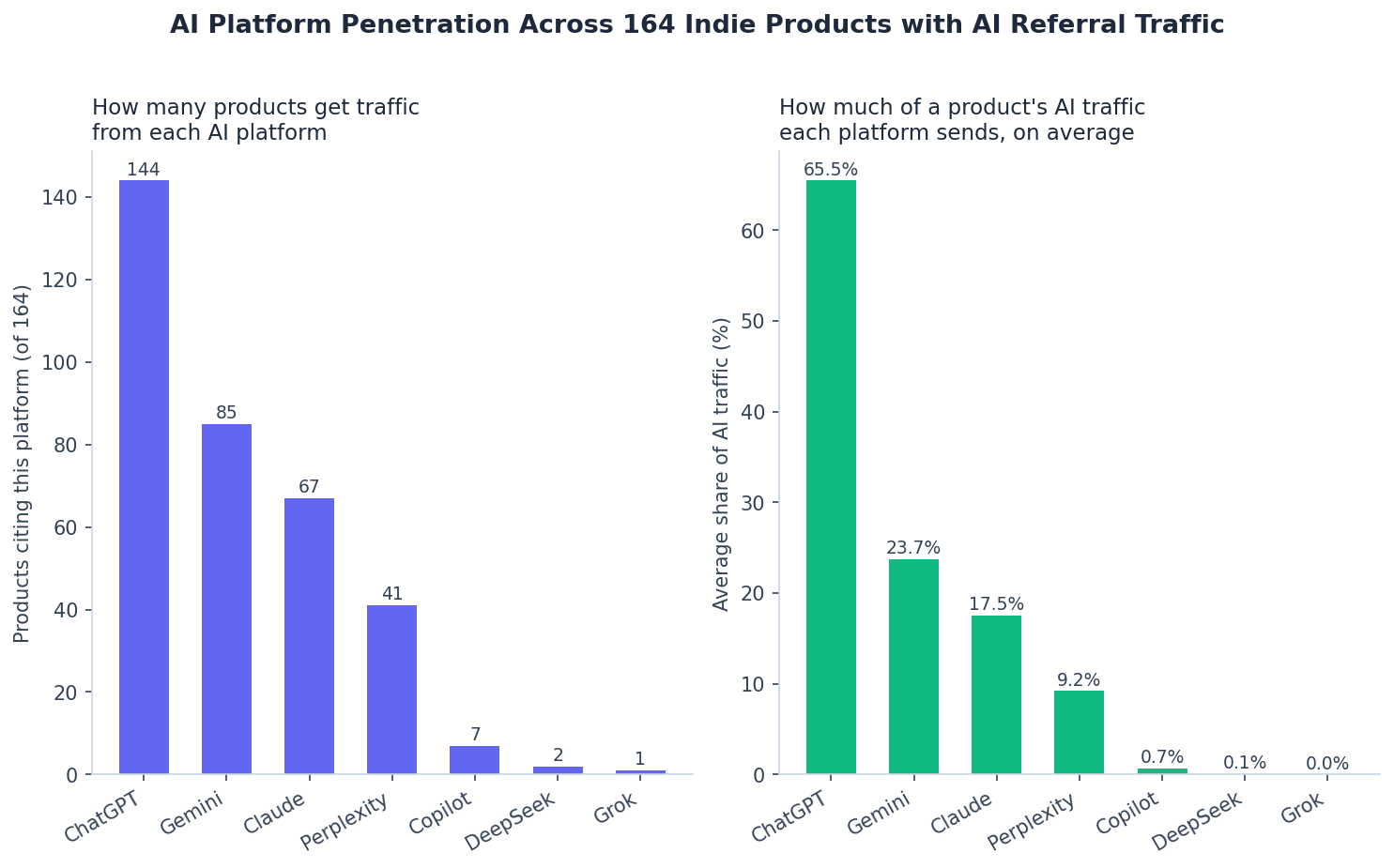 ChatGPT dominates on both dimensions — the most products cite it (87.8%), and it supplies the largest average share of AI traffic where it appears.
Of the seven AI platforms Similarweb tracks, ChatGPT (chatgpt.com) appears in 144 of 164 products — 87.8% — and where it appears, it supplies an average of 65.5% of that product's total AI-sourced traffic. Nothing else comes close on either dimension:
- Gemini appears in 85 products (51.8%), averaging 23.7% of AI traffic where present.
- Claude appears in 67 products (40.9%), averaging 17.5%.
- Perplexity appears in 41 products (25.0%), averaging 9.2%.
- Copilot, DeepSeek, and Grok together appear in only 10 products combined, each contributing under 1% on average.
A few products buck the trend in an interesting way — a handful get the majority of their AI traffic from Claude or Gemini specifically rather than ChatGPT, which we'll get to in the case studies below. But as a rule, if you can only test your product's visibility in one assistant, test it in ChatGPT first; it's both the most common source and the largest single contributor everywhere else it shows up alongside.
Which categories AI assistants recommend most
AI referral traffic isn't evenly spread across the kinds of products indie makers build. It clusters hard around visual and creative resources.
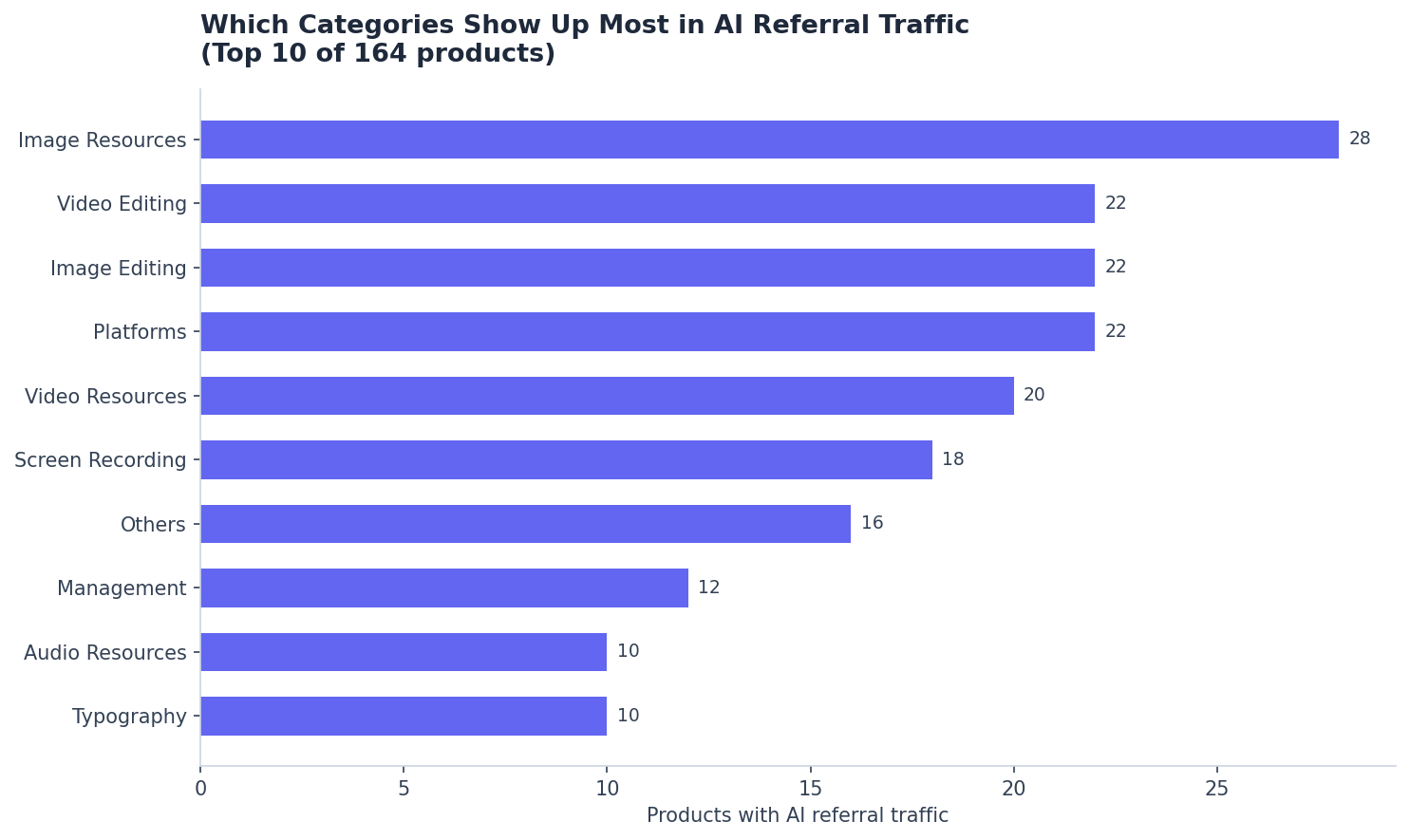 Image and video tools dominate the category breakdown — a pattern consistent with how people phrase creative-tool questions to AI assistants.
Image Resources leads with 28 of the 164 products, followed closely by Video Editing (22), Image Editing (22), and Platforms (22), then Video Resources (20) and Screen Recording (18). Together, image- and video-related categories account for well over half of the dataset.
This lines up with how people actually phrase requests to chat assistants: "find me a free stock video site," "what's a good screen recorder for Mac," "how do I convert this video file" — these are exactly the kind of concrete, single-answer questions where an AI assistant can confidently name a specific tool instead of returning a list of ten blue links. Categories that are more subjective, workflow-dependent, or require comparing many options side by side (like broad SaaS platforms or niche B2B tools) show up far less, likely because the "right answer" is less obvious to an AI model and more dependent on the user's specific situation.
Does AI traffic correlate with growth?
This is the question we most wanted to answer, and it required joining our AI-referral dataset against our separate high-growth dataset (products with at least +20% month-over-month growth) by product slug.
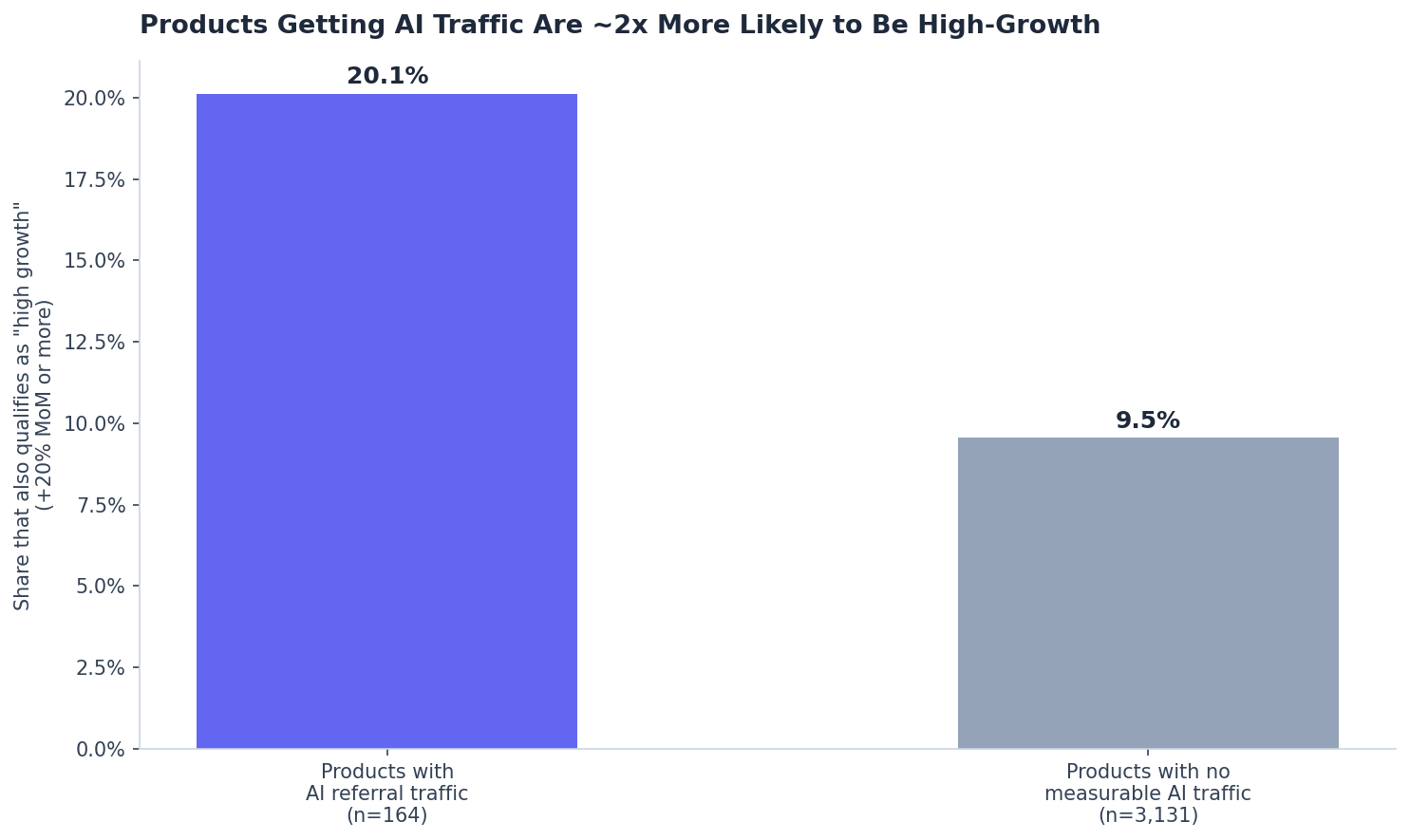 Products with any AI referral traffic are about twice as likely to also be growing fast month-over-month.
Of the 164 products with AI referral traffic, 33 (20.1%) also qualify as high-growth in our separate dataset. Among the remaining 3,131 measurable indie products with no detected AI traffic, only 299 (9.5%) are high-growth. That's roughly a 2.1x difference in high-growth rate between the two groups.
We can't settle causality with this data, and there are at least two plausible stories that aren't mutually exclusive: AI traffic could be driving new visitors who stick around and compound into growth, or growth could be a side effect of the same things that make a product AI-citable in the first place — recent content, backlinks, press mentions, community discussion. Realistically it's probably both, reinforcing each other. Either way, the practical takeaway holds: shipping visibly and keeping documentation current appears to help on both fronts at once.
Five products actually getting AI traffic
Numbers are more useful with faces attached. Here are five real products from the dataset — each explanation below is our informed guess, not query-level data we actually have access to.
HandBrake — the highest AI-traffic share in the dataset at 6.3% of its 1.6M monthly visits (91% from ChatGPT). Free, open-source video transcoding software with 20+ years of documentation, forum threads, and tutorials behind it. Guess: "how do I compress an MP4" is a common, low-ambiguity question, and HandBrake's documentation depth makes it the default answer.
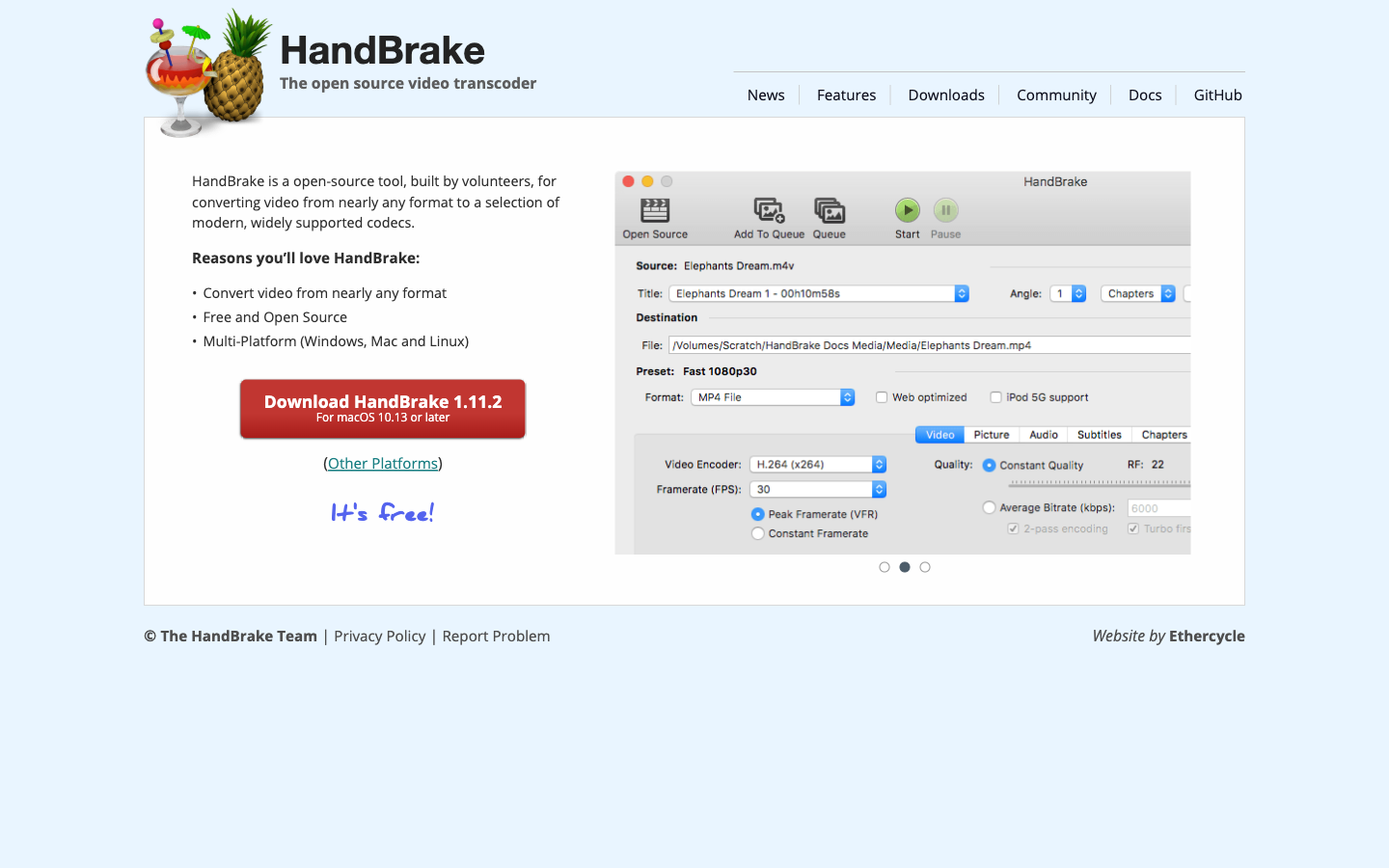 HandBrake's homepage — plain, documentation-heavy, and unmistakably answering one specific question, which is likely why ChatGPT reaches for it.
Hailuo AI — 6.1% share on 2.7M monthly visits, 98.5% from ChatGPT. An AI video generation tool that benefits from a double effect: people ask ChatGPT to recommend AI video generators, and it's a well-known, active entrant in that exact category.
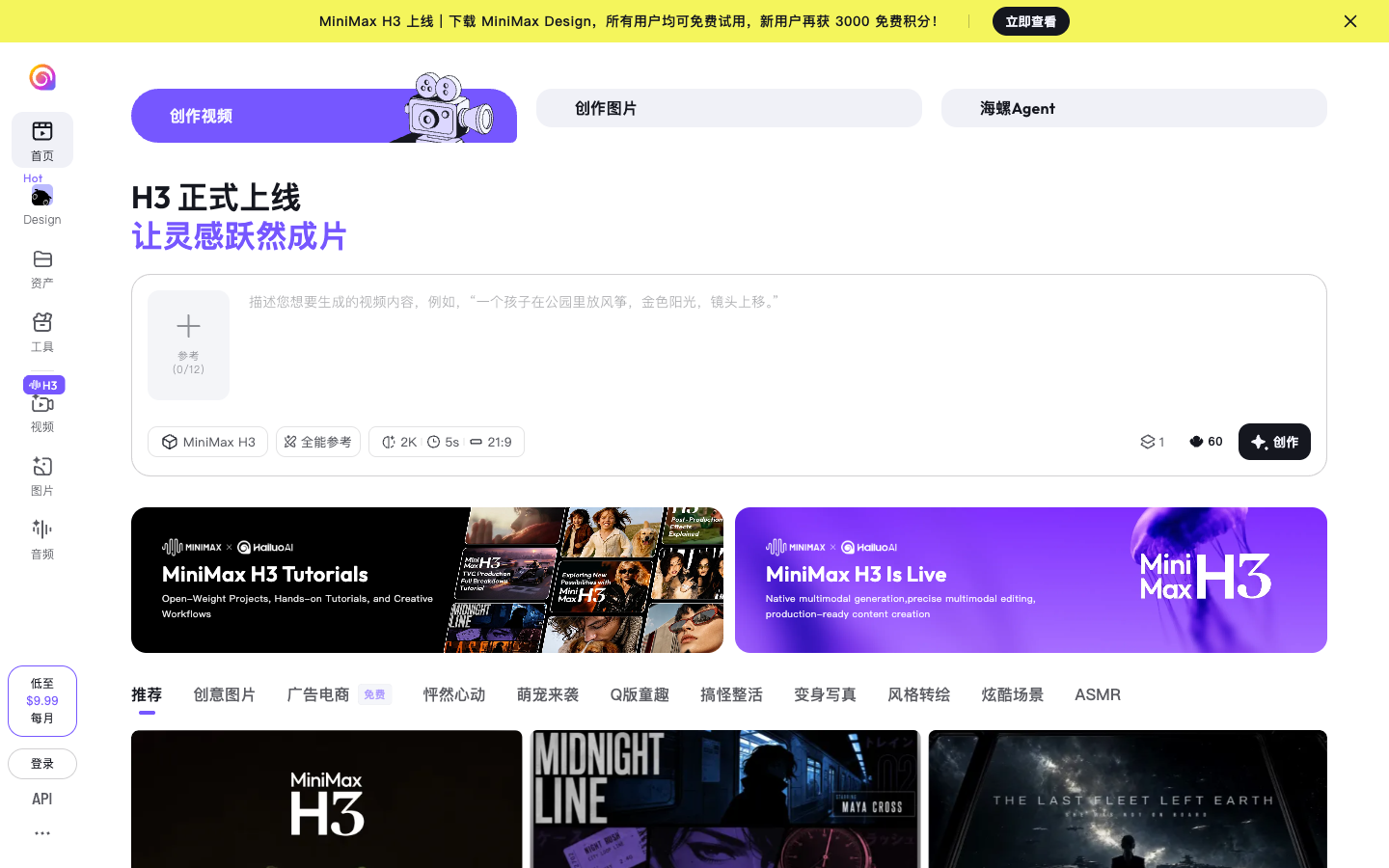 Hailuo AI's homepage — an active, frequently updated AI video generator, the kind of visible product launch activity that keeps a tool top-of-mind for a model.
Bolt.new — 5.2% AI share on 3.8M monthly visits, 93.8% from ChatGPT. A prompt-to-app builder, part of the AI-coding-tool wave that gets discussed constantly across launch posts, comparisons, and walkthroughs — the kind of public discourse a model can recall by name.
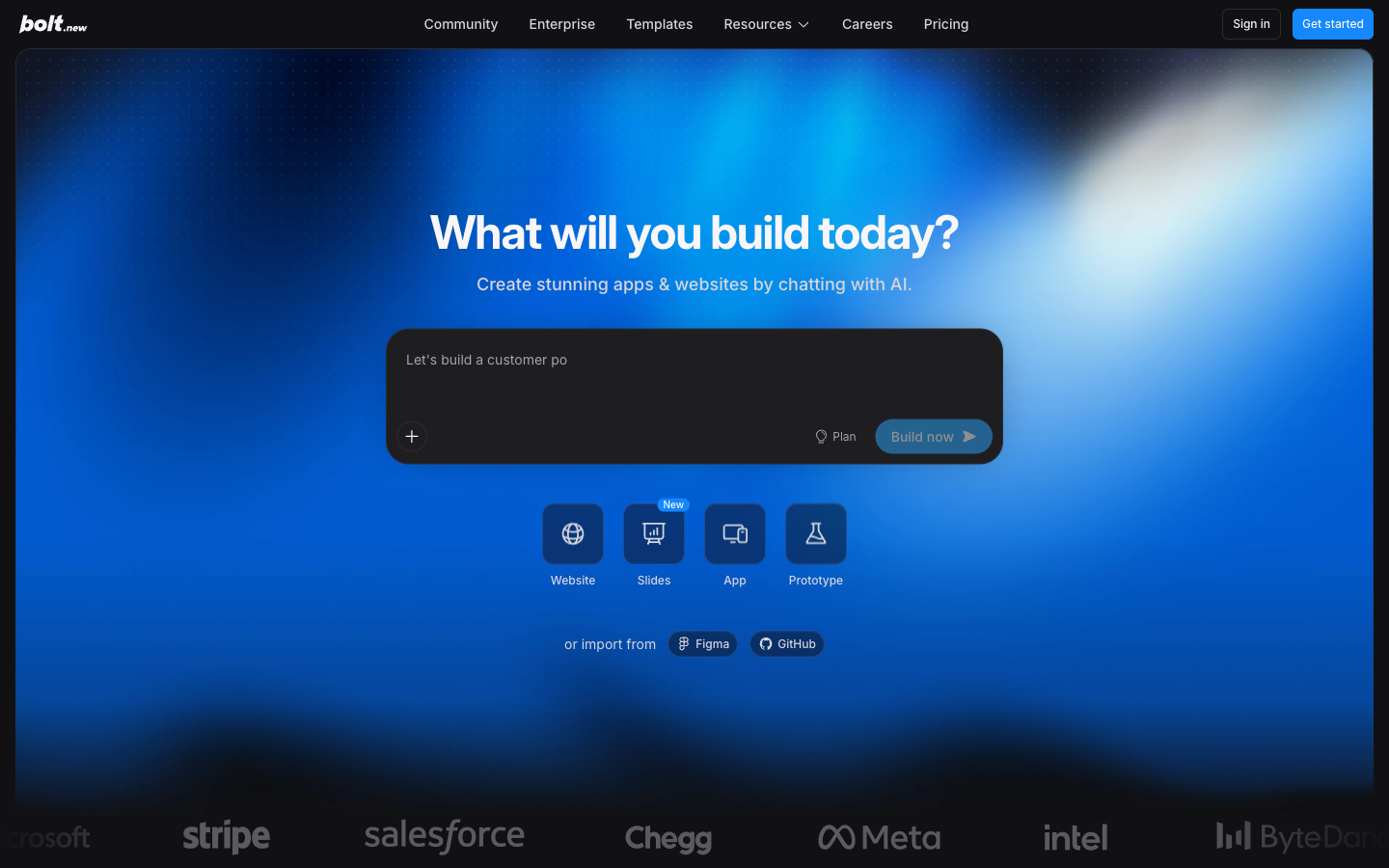 Bolt.new's homepage — one of the most-discussed AI coding tools, the kind of product that shows up constantly in launch threads and comparisons a model can draw on.
Mixkit — 3.9% AI share on 3.7M monthly visits, 89.3% from ChatGPT. A free stock video, music, and sound-effects library that answers one very specific, repeatable request: "free stock footage, no attribution required."
DatePhotos.AI — a much smaller tool at 29,820 monthly visits, notable because its AI referral traffic (1.9% share) is 100% from Claude, not ChatGPT — the opposite of every case above. It's also growing +76.5% month-over-month, making it a concrete instance of the AI-traffic-and-growth overlap discussed earlier, and a reminder that ChatGPT's dominance is a population-level pattern, not a guarantee for every product.
How to make your product easier for AI to recommend
Nobody outside the AI labs knows the exact retrieval or training pipeline, but the pattern in this dataset — well-documented tools, specific use cases, active public discussion — points toward a few concrete, low-risk practices:
- Write a clear, literal product description. AI assistants tend to recommend tools by restating what they do in plain language. Give the model — and human visitors — a one-sentence, jargon-free description near the top of your homepage.
- Add structured data. Schema.org markup (
SoftwareApplication,Product,FAQPage) gives crawlers and AI ingestion pipelines an unambiguous, machine-readable summary of what your product is, its pricing, and its category, reducing the guesswork a model would otherwise do from prose alone. - Get listed in directories that AI systems actually crawl. Directory listings are structured, categorized, and frequently updated — efficient sources for both search engines and AI retrieval. Every product on Turbo0 gets a structured listing with category tags, pricing, and a description: exactly the clean, indexable data that's cheap for automated systems to ingest. If your product isn't listed yet, submitting it to Turbo0 takes a few minutes and costs nothing.
- Keep an
llms.txtfile current. An emerging, still-informal convention where sites publish a plain-text summary of their content specifically for AI consumption, similar in spirit torobots.txtfor crawlers. Low-cost to maintain, and forward-looking even while adoption is early. - Publish content that answers specific, repeatable questions. The winning products here solve a narrow, clearly-named problem ("convert this video," "free stock footage") rather than a broad, ambiguous one. A dedicated page answering that exact question in plain language is more likely to match how AI assistants retrieve and cite sources.
A note on the data
This report uses Similarweb's AI-platform referral estimates as surfaced through Turbo0's product tracking, snapshotted on August 9, 2026. Similarweb's AI-referral attribution is itself an estimate, not first-party analytics from each product's own dashboard, so absolute percentages should be read as directional rather than precise. The 3,295-product denominator only includes indie listings (capped at 5M monthly visits) with Similarweb visit-history data at all — many more Turbo0 listings exist without measurable traffic data yet. And the growth correlation above is just that: a correlation observed at a single point in time, not a controlled experiment.
If you're building an indie product and want a low-effort way to become one of the structured data sources AI systems can point to, submit it to Turbo0 — the resulting directory listing is exactly the kind of clean, categorized data this report suggests AI assistants are already citing.