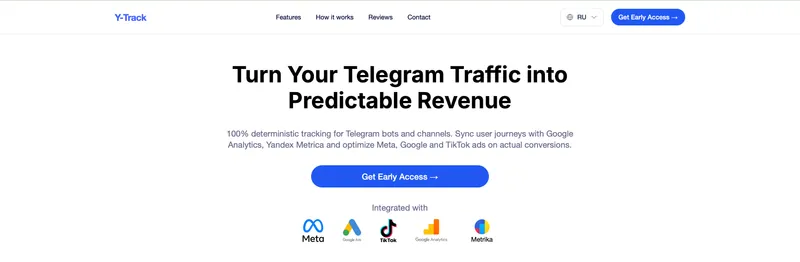
Y-Track is a Telegram conversion-tracking platform that binds ad clicks from Meta, Google Ads and TikTok to a unique telegram_id, then forwards the resulting subscribe, checkout and purchase events back to ad networks via Conversions API and into Google Analytics 4 or Yandex Metrika.
What is Y-Track?
Y-Track is an attribution and analytics tool built specifically for traffic that leaves an ad network and lands inside a Telegram bot or channel. It takes inbound campaign parameters from ad clicks as input, links them to a Telegram user ID, logs in-bot actions such as button clicks, onboarding steps and checkout events, and outputs conversion data to two destinations: ad platforms through CAPI and analytics suites such as GA4 and Yandex Metrika. It runs as a web dashboard plus a native Telegram Mini App, and is currently offered through an early access signup rather than open self-serve plans.
What makes Y-Track stand out?
- Deterministic click-to-ID attribution — campaign parameters captured at the ad click are matched to a unique
telegram_idthe moment the user lands in the bot or channel, with no cookie or probabilistic matching involved. - Google Analytics 4 and Yandex Metrika sync — custom events, conversion milestones and revenue flow into standard GA4 reports and Metrika, so Telegram journeys sit alongside web data.
- Conversions API (CAPI) feedback — real conversion signals are sent server-side to Meta, bypassing pixel limitations and browser tracking blocks; Google Ads and TikTok ads are also listed as supported ad networks.
- Automated offline events sync — Telegram IDs are matched against Meta user profiles so offline in-bot conversions are credited to the right campaigns.
- Web dashboard plus Telegram Mini App — the same account works on desktop and mobile, with unified Telegram authentication and no separate login per device.
- Published performance targets — event latency under 50 ms, 100% deterministic accuracy claimed, and an average 30–40% cost-per-lead reduction attributed to CAPI-based algorithm training.
- Cookie- and iOS-resistant measurement — because tracking lives inside the messenger rather than a browser, cookie restrictions and iOS tracking limits do not interrupt the data flow.
Who should use Y-Track?
- Performance marketers running Meta Ads into Telegram — they send subscription and purchase events back through CAPI so the algorithm stops bidding for cheap bot clicks and starts finding paying users.
- Telegram bot owners with paid funnels — they map every onboarding step and in-app checkout to a conversion event and see which campaigns produced revenue rather than starts.
- Analytics and growth analysts — they pull Telegram user journeys into GA4 or Yandex Metrika to calculate true ROAS next to their existing web data.
- Agencies managing TikTok and Google Ads for messenger businesses — they compare ad-network spend against confirmed sales inside the channel instead of landing-page metrics.
How does Y-Track work?
Setup follows three stages described on the site. First, Y-Track captures inbound campaign parameters when a user clicks a Meta, Google Ads or TikTok ad and links them to a telegram_id on arrival in the bot or channel. Second, every in-bot action — button clicks, onboarding steps, checkout events — is logged against that ID. Third, revenue and downstream conversion events are pushed back to the ad platforms via CAPI and into GA4.
What can you do with Y-Track?
- Cut wasted ad spend: feed real purchase and subscription events into Meta's algorithm and target buyers instead of click-throughs, which the page credits with a 30–40% lower cost per lead.
- Measure true ROAS per campaign: route Telegram conversion milestones and revenue into GA4 reports so messenger sales appear next to paid-channel costs.
- Monitor funnels on mobile: open the Telegram Mini App to check real-time conversion metrics and campaign ROAS without switching to a desktop dashboard.
- Reconcile offline conversions: use automated offline event sync to attach in-bot purchases to the correct Meta profiles and campaigns.
FAQ
How is Y-Track different from a tracking pixel?
Y-Track does not rely on browser cookies or a pixel. It matches ad clicks to a persistent telegram_id inside the messenger, which the company describes as 100% deterministic attribution that is unaffected by cookie restrictions or iOS tracking limits.
Which ad platforms and analytics tools does Y-Track connect to?
The site lists Meta Ads, Google Ads and TikTok Ads for conversion feedback through CAPI, plus Google Analytics 4 and Yandex Metrika as analytics destinations. Meta is the only network with documented CAPI and offline-event matching detail on the page.
Is Y-Track publicly available?
Y-Track is in early access: the only call to action on the page is "Get Early Access." No pricing tiers, free plan or self-serve signup are published, so cost and availability have to be confirmed with the vendor.
Does Y-Track work for channels as well as bots?
Yes. Deterministic attribution covers users landing in either a bot or a channel, and the page refers to tracking button clicks, onboarding and in-app checkout events inside both.