Newsletter
Join the Community
Subscribe to our newsletter for the latest news and updates
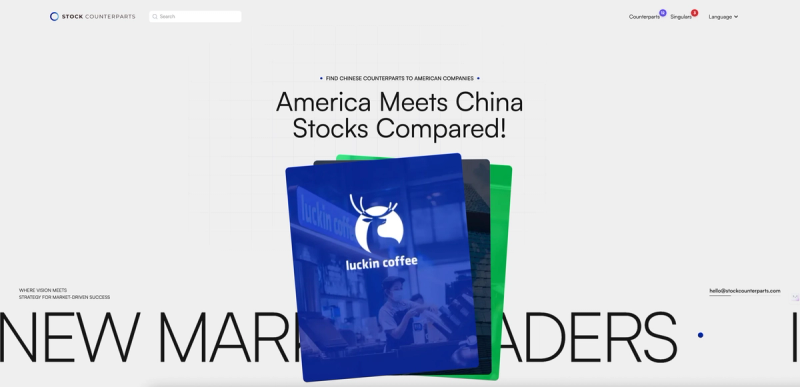
StockCounterparts compares top US stocks with their Chinese counterparts in a clear side by side format. Concise profiles cover business models, China dynamics, and growth drivers, plus Singulars for companies without a US match.
Traffic, search & AI signals for www.stockcounterparts.com.
Third-party traffic estimate · Updated Aug 9, 2026
Submit your own product to reach creators and founders looking for the next tool to try.
StockCounterparts compares top US stocks with their Chinese counterparts in a clear side-by-side format, mapping rivalries across sectors so investors and builders spot where market leadership is shifting. The platform publishes concise company profiles that explain business models, China-specific dynamics, and growth drivers, plus a set of “Singulars” for Chinese companies with no direct US equivalent.
StockCounterparts is a research platform that takes US public companies and finds their Chinese equivalents, producing structured profiles that detail business model, market position, financials, and ecosystem context. The platform runs on a website (stockcounterparts.com) and is maintained by founder Dominik Diemer, who created it to address the blind spot most investors have toward Chinese competitors.
The site follows a three-step methodology: 1) Map the Duopoly — identify counterpart pairs across tech, automotive, finance, and more. 2) Understand Both Sides — deep-dive into each pair’s business model, market position, financials, and ecosystem. 3) Build a Global Portfolio — use the counterpart pairs to spot structural opportunities and diversify beyond geography.
Note: The site presents research and education, not financial advice.