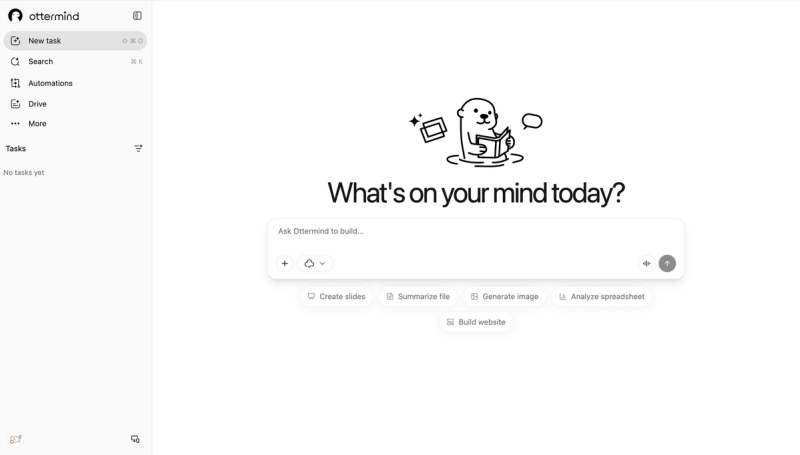
Ottermind is an AI agent workspace that turns ideas into finished deliverables by orchestrating agents, retaining project context, and connecting to external tools.
What is Ottermind?
Ottermind is an AI agent workspace built for real work. It takes your thoughts, files, and workflows as input and produces finished outputs like slides, images, videos, websites, and analyses. The platform runs in the cloud, accessible via desktop and mobile, and works with models like Claude, OpenAI, and Minimax, as well as tools like Notion, Google, Slack, GitHub, and Stripe.
What makes Ottermind stand out?
- Retains context — Files, decisions, and history stay organized around each project, so agents build on past conclusions and brand guidelines.
- Acts across tools — Agents work directly with documents, code environments, plugins, and connected services such as Supabase, Linear, Make, and Netlify.
- Adapts to you — The system learns your preferences, patterns, and recurring context through ongoing collaboration, improving future outputs.
- Works everywhere — Start a task on your phone and finish on desktop, or let longer tasks run autonomously in the cloud.
- Example tasks built in — The showcase demonstrates creating slides, generating images, summarizing files, creating videos, analyzing spreadsheets, and building websites.
- Resilient execution — If an agent hits an error, it can inspect logs, adjust its approach, and recover; critical actions still require your approval.
- Privacy controls — You decide what gets connected, remembered, and used by agents, with boundaries between local files, cloud tasks, connected tools, project memory, and model usage.
Who should use Ottermind?
- Knowledge workers who need to distill long meetings or documents into concise summaries, then turn them into actionable plans.