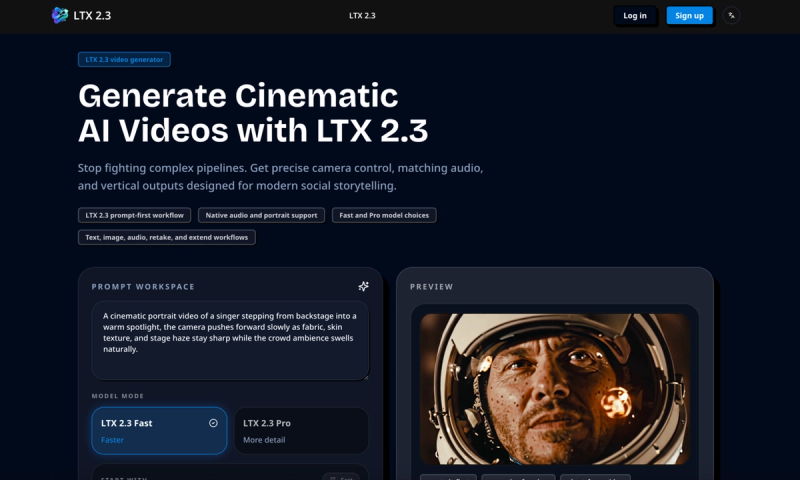
LTX 2.3 is an AI video generator for creating cinematic short-form videos with precise control over camera movement, audio, and vertical framing. Built on Lightricks' open-weight model, it produces 1080p video clips up to 6 seconds from text prompts or images, with optional audio generation, and runs in-browser at ltx23ai.com.
What is LTX 2.3?
LTX 2.3 is a diffusion-based text-to-video (and image-to-video) model from Lightricks. It takes natural-language prompts (or images) as input and outputs MP4 video clips at 1080p resolution, 25 FPS, in 16:9 or 9:16 aspect ratios, with native audio alignment. The platform at ltx23ai.com provides a web-based workflow to generate videos using Fast or Pro model modes, and supports prompt-controlled camera motion, audio sync, and portrait framing.
Key Features
- DiT Architecture with Temporal Reasoning — Ensures motion and timing are more coherent across frames, reducing flicker and improving scene consistency.
- Native Audio Awareness — Audio intent written into the prompt aligns sound events with visual motion, avoiding post-production sync issues.
- Native Portrait Support (9:16) — Outputs framed natively for vertical platforms (Reels, Shorts, TikTok) without cropping, preserving composition quality.
- Fast and Pro Model Modes — Fast mode (lower cost, faster generation) for ideation and iteration; Pro mode for richer texture retention and polished final renders.
- Text-to-Video & Image-to-Video — Accepts either a text prompt or an image as the starting frame, with optional audio generation.
- Camera Motion Control — Preset camera moves (e.g., push-in, pan, static) can be specified in the prompt for directed cinematography.
- Credits-Based Usage — Each video costs 6 credits; credit packs available: Starter (20 clips), Creator (53 clips), Studio (120 clips).
Who is it for?
- Short-form content creators — Generate vertical social videos (Reels, TikTok) with native 9:16 framing and audio sync, ideal for hooks, teasers, and storytelling.
- Product marketers — Create close-up product shots with high texture retention for beauty, packaging, or luxury goods, using macro-style prompts.
- Interior and architecture designers — Produce before/after transformation clips or room walkthroughs that maintain spatial structure for design portfolios or real estate.
- Faceless content producers — Make ASMR, satisfying loops, or ambient visual clips where sound cues drive timing and mood, without showing a person.
What can you do with LTX 2.3?
- Create cinematic ad hooks — Use Fast mode to iterate on quick motion sequences for ads or social openings, then switch to Pro for final polish.
- Generate texture-driven product close-ups — Write macro lens prompts detailing surface, lighting, and slow camera movement to preserve embossing, droplets, and fabric detail.
- Produce portrait-first story clips — Leverage native 9:16 output for founder stories, educational content, or brand narratives that feel made for mobile screens.
- Design audio-synced scenes — Embed sound events in the prompt (e.g., “ambient studio hum with fingertip friction”) to get single-pass clips where motion and audio align naturally.
How does LTX 2.3 work?
- Write a single natural-language paragraph describing subject, action, camera motion, lighting, and any sound intent. 2. Choose a model mode (Fast or Pro) and resolution (1080p). 3. Optionally upload an image for image-to-video. 4. Click “Generate video” — each generation consumes 6 credits. Use Fast to explore, Pro to finalize.
Pricing
Credit-based: Starter pack (20 clips), Creator pack (53 clips), Studio pack (120 clips). Each video costs 6 credits. No free tier visible; exact dollar amounts are not stated.
FAQ
What is LTX 2.3?
LTX 2.3 is an open-weight video generation model from Lightricks that creates short 1080p clips from text or image inputs. It supports native audio awareness, vertical framing, and controllable camera motion, making it suited for rapid social video production.
How long are LTX 2.3 videos?
Maximum duration is 6 seconds. Shorter clips are recommended for coherence and clean output, especially for social-first formats.
What resolutions and aspect ratios are supported?
Output is 1080p (1920x1080) in 16:9 or 9:16 aspect ratios. 9:16 is natively generated for vertical use, avoiding post-crop quality loss.
Does LTX 2.3 generate audio?
Yes, audio can be generated as part of the video when the prompt includes sound cues. This is a distinct advantage over models that require separate audio post-production.
How is LTX 2.3 different from Wan 2.2?
Wan 2.2 is often chosen for strong image-to-video quality and broader model variants, while LTX 2.3 emphasizes speed, natural-language prompting, native audio intent, and vertical-first creator workflows. The best choice depends on whether you prioritize final fidelity, experimentation speed, or distribution format.