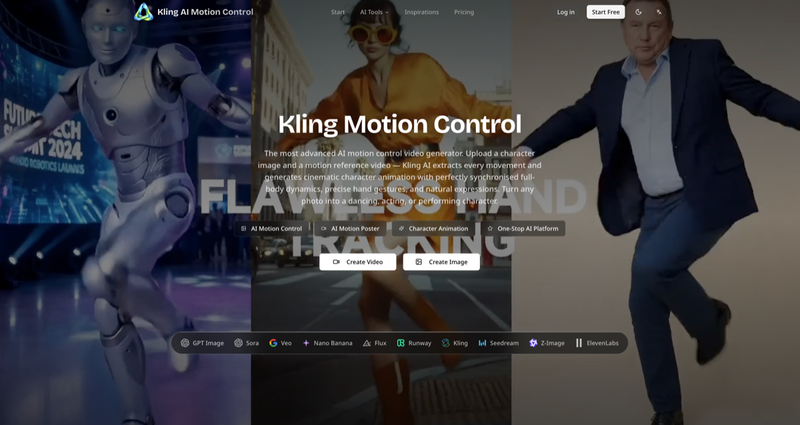
Kling AI Motion Control is a web-based AI tool that transfers motion from a reference video onto a character image, generating realistic animated clips up to 30 seconds long.
What is Kling AI Motion Control?
Kling AI Motion Control is a video generation feature within Kling AI (versions 2.6 and 3.0) that creates character animations by mapping movements from a reference video onto a static image. It accepts a reference image (JPG/PNG, up to 10MB, min 340px short edge, max 3850px long edge, aspect ratio 2:5 to 5:2) and a reference video (MP4/MOV, up to 50MB, 3–30 seconds, single continuous shot). The output is a video in 720p or 1080p resolution, up to 30 seconds in Video orientation or 3–10 seconds in Image orientation. The platform is developed by Kuaishou and runs entirely in the cloud.
Key Features
- Full-Body Motion Sync — Captures joint positions, body dynamics, and weight transfer from the reference video to synchronize full-body movements with the character image.
- Hand Precision — Preserves finger-level gestures such as pointing, grasping, and fine motor movements, offering higher hand fidelity than competitors like Viggle AI and Animate Anyone.
- 30s One-Shot Action — Generates up to 30 continuous seconds of motion control video in a single pass in Video orientation mode, the longest among similar tools.
- Scene Detail Control — Optional text prompts (up to 2,500 characters) let users influence background, clothing, lighting, and environment while motion is sourced entirely from the reference video.
- Camera Movement — In Image orientation mode, supports prompts for Zoom In, Zoom Out, Camera Up, Camera Down, or Fixed Position.
- Dual Resolution Output — Standard 720p for fast iteration and 1080p for production-quality results, both maintaining character identity.
- Two Orientation Modes — Image orientation preserves aspect ratio with 3–10s output and camera controls; Video orientation matches reference video framing for 3–30s full performances.
Who is it for?
- Content creators — produce dance videos, social media animations, or character-driven clips without needing motion capture equipment.
- Marketers — create dynamic motion posters for advertising and brand content by applying subtle movements (breathing, blinking) to static product or character images.
- Animators and filmmakers — streamline animation workflows by using reference videos as motion sources for character animation, saving time on manual keyframing.
What can you do with Kling AI Motion Control?
- Dance and performance videos — upload any dance reference choreography (freestyle, TikTok trends, professional) and a character image to generate a video where the character performs the same moves with full-body and hand precision.
- AI motion posters — transform static product images, illustrations, or mascots into scroll-stopping animated posters with natural breathing, gestures, and eye movement.
- Complex action sequences — apply martial arts, fitness routines, sign language, or multi-gesture performances from a reference video to a character image, with the model handling rapid transitions and continuous actions.
How does Kling AI Motion Control work?
- Upload inputs — provide a reference image (JPG/PNG) and a reference video (MP4/MOV, 3–30s). Optionally add a text prompt up to 2,500 characters.
- AI generation — Kling AI extracts motion frame-by-frame from the reference video and maps it onto the character, applying it with synchronized body dynamics and hand gestures. Choose resolution (720p or 1080p).
- Download — the generated video is ready for commercial use in social media, advertising, music videos, or animation projects.
Alternatives
- Viggle AI — an AI character animation tool, but lacks Kling’s hand precision and 30s single-generation output.
- Animate Anyone — a motion transfer framework, typically producing shorter clips and lower hand fidelity compared to Kling AI Motion Control.
FAQ
Is Kling AI Motion Control free?
The platform operates on a freemium model with credit-based usage. Kling 3.0 motion control consumes 20–27 credits per second of video generated. Free credits may be available upon sign-up; exact pricing tiers are not listed on the page.
Reference image must be JPG/PNG, up to 10MB, with minimum 340px short edge and maximum 3850px long edge, aspect ratio between 2:5 and 5:2. Reference video must be MP4/MOV, up to 50MB, 3–30 seconds, single continuous shot.
How long can a generated video be?
In Video orientation mode, up to 30 seconds per generation. In Image orientation mode, up to 10 seconds. Both support 720p and 1080p resolution.
Can I use any video as a motion reference?
Yes, as long as it meets the format and size specifications. Popular uses include dance choreography, martial arts, fitness routines, and sign language — the AI extracts valid continuous action segments.
What resolution options are available?
Standard 720p for faster generation and social media use, and 1080p professional resolution for broadcast-ready output. Both maintain character identity consistency.