Newsletter
Join the Community
Subscribe to our newsletter for the latest news and updates
Dunk Calculator - How High Do You Need to Jump to Dunk?
Traffic, search & AI signals for www.dunkcalculator.online.
Third-party traffic estimate · Updated Sep 9, 2026
Submit your own product to reach creators and founders looking for the next tool to try.
Dunk Calculator is a free online tool that calculates the exact vertical jump height you need to dunk a basketball based on your height, standing reach, and target rim height.
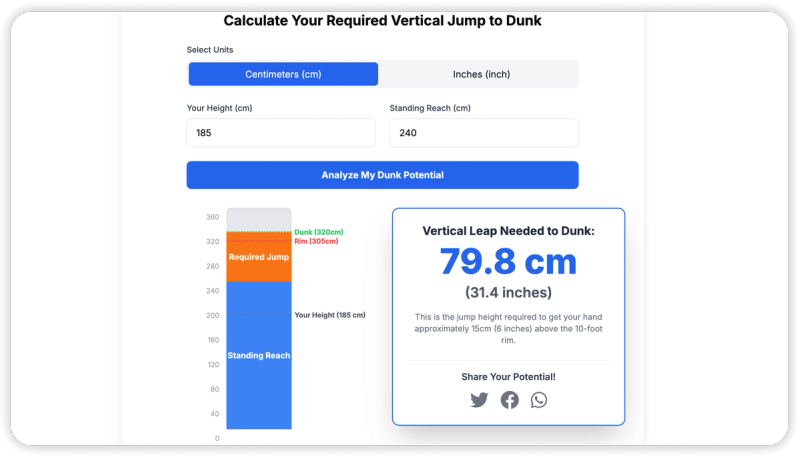
Dunk Calculator takes your height and standing reach (in centimeters or inches) and a target rim height (default 305 cm, the NBA standard) and outputs the precise vertical leap required to dunk, including a 15 cm wrist clearance. It runs in any web browser with no account required. The tool was created by an independent developer.
Standing Reach is the maximum height you can touch with one hand while standing flat-footed. To measure, stand beside a wall, reach up as high as possible, have a friend mark the point, and measure from floor to mark.
The official NBA rim height is 10 feet (305 cm). This standard is used across NBA, WNBA, NCAA, and FIBA. Younger players often use lower rims (6-9 feet).
Yes. Height is not the limiting factor; vertical jump is. Players like Spud Webb (5'7") have won NBA dunk contests. A high vertical leap can compensate for shorter stature.
With consistent training, measurable improvements can be seen in 4-6 weeks. Significant gains of several inches typically take 3-6 months.
Yes, because it uses fixed standards and a scientific buffer. Accuracy depends on precise measurement of your standing reach. The result is your required vertical jump, not accounting for a running start which can add height.