Montoyer Agents (AI for EU) is an open-source, domain-specific multi-agent framework that models the internal machinery, workflows, and legislative procedures of the European Union, producing structurally realistic drafts for official review. Most AI products for professionals still work like generic chatbots with better branding, but policy work inside the EU quarter depends on institutional context, legal procedure, multilingual documentation, committee structures, delegated acts, trilogues, procurement rules, interservice consultations, and years of accumulated administrative logic. General-purpose AI doesn't understand that environment — so we built Montoyer Agents.
What is Montoyer Agents?
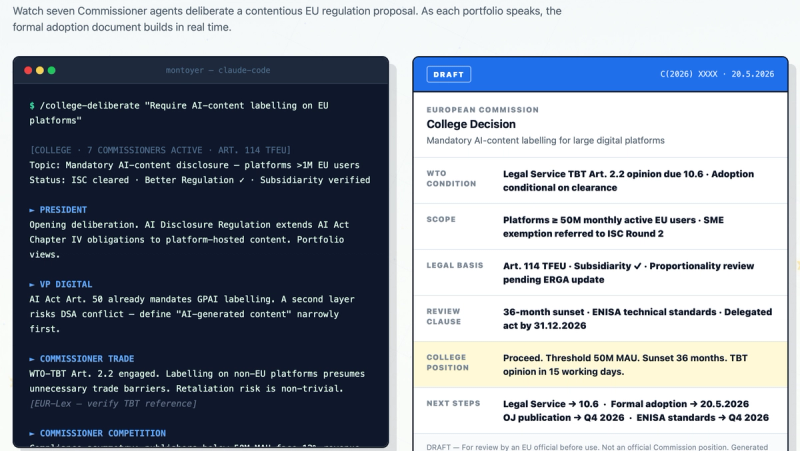
Montoyer Agents is a multi-agent framework that takes natural-language commands (e.g., /impact-assessment "policy brief" or /college-deliberate "proposal") and produces structured EU documents — inter-service consultation replies, impact assessments, Data Protection Impact Assessments, legal-basis checks, and full legislative simulations. It runs primarily in Claude Code for the full agent experience, but all prompts are also available as self-contained blocks in the EU Prompt Library that work with GPT@EU, ChatGPT, Gemini, or Copilot. The framework is open source under the European Union Public Licence (EUPL-1.2) and maintained by Montoyer, an independent project.
Key Features
- 21 Commissioner Personas — Individual portfolio agents (Competition, Trade, Green Deal, etc.) with conflicting mandates that simulate real College dynamics; compound commands like
/mandate-conflictsurface structural fault lines automatically. - 106 Slash-Command Skills — One command per real EU motion:
/treaty-checkverifies legal basis,/dpiaproduces an Art. 39 EUDPR assessment with five specialist roles,/subsidiarity-stresstests necessity against five member-state configurations. - 9 Domain Plugins — Installable capabilities covering legislative, competition, privacy, simulation, grants, trade, institutional management, data/communication, and EU careers; plugins live in
plugins/*/skills/and can be added individually. - Inline Attribution Architecture — Every legal citation is cross-referenced against local JSON treaty schemas and live CJEU records via scripts like
post_tool_use_citation_matcher.sh, injecting visible validation tags (e.g.,[EUR-Lex — verify current version]) directly into the output. - Multi-Platform Compatible — Paste prompts into GPT@EU, ChatGPT, Gemini, or Copilot for instant drafts, or install the full framework in Claude Code for multi-agent workflows over local files.
- Freely Accessible Code — Entirely open source under EUPL-1.2; no paid tiers, no accounts required; inspect every file and contribute via the GitHub repository.
Who is it for?
- Commission officials and contract agents drafting ISC replies, impact assessments, briefings, or PQs — get structurally correct first drafts that respect real procedures.
- Assistants and HoU support preparing agendas, mission orders, and lines to take — use
/pq-responderfor draft PQ replies or/procurement-expertfor Financial-Regulation-based procurement files. - IT consultants under framework contracts (DIGIT TM/SM) — gain EU context fast without deep institutional knowledge by running
/impact-assessmentor/treaty-checkon a proposal. - Researchers, educators, and civic tech builders — simulate College deliberation, trilogue negotiations, or full legislative cycles to understand how files move through the EU system.
What can you do with Montoyer Agents?
- Draft an inter-service consultation reply —
/eu-legislative:isc-contributor <file>produces a structured position with legal-basis flags, ready for official review. - Stress-test a proposal at College —
/eu-simulation:red-team-college <proposal>runs it through all 21 Commissioners, returning only the severe objections with their legal basis. - Produce a DPIA —
/eu-privacy:dpia <system>generates a full Article 39 EUDPR assessment voiced by five specialist roles (DPO, IT architect, legal officer, etc.), tagged for verification. - Run a full legislative cycle —
/legislative-cycleorchestrates a sequence: policy brief → inter-service consultation → College adoption → trilogue simulation.
How does Montoyer Agents work?
Install the plugins in Claude Code via /plugin marketplace add montoyer/eu-agents and /plugin install eu-simulation. Then type any slash-command (e.g., /college-deliberate "Ban PFAS by 2030") — the framework routes the request to the appropriate agent personas, applies institutional rules, and returns a structurally correct draft. For quick use without installation, copy any prompt from the EU Prompt Library and paste it into a GPT-like tool.
Pricing
Montoyer Agents is completely free and open source — no paid tiers, no licence fees, no account required. You only need access to an AI tool (GPT@EU, ChatGPT, Gemini, Copilot, or Claude Code) to run the prompts.
FAQ
Is Montoyer Agents an official EU tool?
No. Montoyer Agents is an independent, open-source project. All outputs are explicitly marked as DRAFT — for review by an EU official before use. They do not represent official Commission positions, legal opinions, or policy stances.
What models does Montoyer Agents support?
The framework is LLM-agnostic. The prompt library works with GPT@EU, ChatGPT, Gemini, Copilot, and any chat interface. The full multi-agent experience with slash commands is built for Claude Code.
Can I trust the legal citations in outputs?
Every citation includes an inline attribution tag (e.g., [EUR-Lex — verify current version]) that flags the need for manual verification. The framework cross-references against local schemas and live CJEU data, but outputs are not legally authoritative.
How do I get started quickly?
The fastest path: browse the EU Prompt Library and paste a prompt into GPT@EU or ChatGPT. For compound commands, install the framework in Claude Code with a single /plugin command.
What are the limitations?
Montoyer Agents produces structural drafts, not official legal opinions. It cannot generate an official Commission position or act as a final legal review. The model works best for research, simulation, and drafting scaffolds that must be refined by human experts.