
Turbo0 currently indexes 6,100 products. As of this writing, 74 of them are confirmed dead — sites that no longer resolve, redirect to a parking page, or have visibly shut down. That's a death rate of about 1.21% of everything we've ever listed.
That number is small on purpose: we don't guess, and we don't mark something dead because traffic dipped for a week. Every one of these 74 was manually verified. This post is what we found looking at all 74 together: which categories lose the most products, how long a typical tool survives before disappearing, and what its pricing model looked like on the way out.
If you're building something right now, treat this as a set of base rates, not a graveyard tour. Some of it will be reassuring. Some of it won't.
How We Know They're Dead
Every product in Turbo0 gets a recurring snapshot of two signals: Ahrefs Domain Rating (DR) and Similarweb traffic estimates, captured weekly and monthly respectively — a small time series per product, so we can watch DR drift and traffic rise, flatline, or drop to zero.
Those series are a signal, not a verdict. When a product's traffic has sat at zero for a while and DR is sliding, it goes on a review list, and someone on the team actually visits the site: still live? redirected to a domain-parking page? DNS even resolving? Only after that manual check does a product get marked dead — it goes onto a confirmed list, and a batch job flags the listing as unavailable in the directory.
One deliberate decision worth calling out: we don't delete dead listings. The page stays up with a visible "This site is no longer available" label, and every outbound link on it — regardless of pricing tier — switches to nofollow. We'd rather keep the historical record than erase it, but won't keep passing link equity to a domain that no longer serves the product it was indexed for.
One honest caveat: 74 is a floor, not a ceiling. Detection has lag — a product can go dark for weeks before its traffic signal drops enough to trigger review, and slow deaths (a site that still loads but hasn't shipped or answered support in a year) never get caught. The real number of abandoned products here is almost certainly higher than 74. What follows is what we can prove, not a full census.
Which Categories Actually Die More
The easy way to slice this is by raw counts: "Others" (18 dead), "Image Editing" (16 dead), and "Platforms" (15 dead) top the list. But raw counts mostly reflect how many products exist in a category in the first place — a category with 1,600 listings will rack up more dead products than one with 100, even at a lower failure rate. What matters is the death rate: dead products divided by total products in that category.
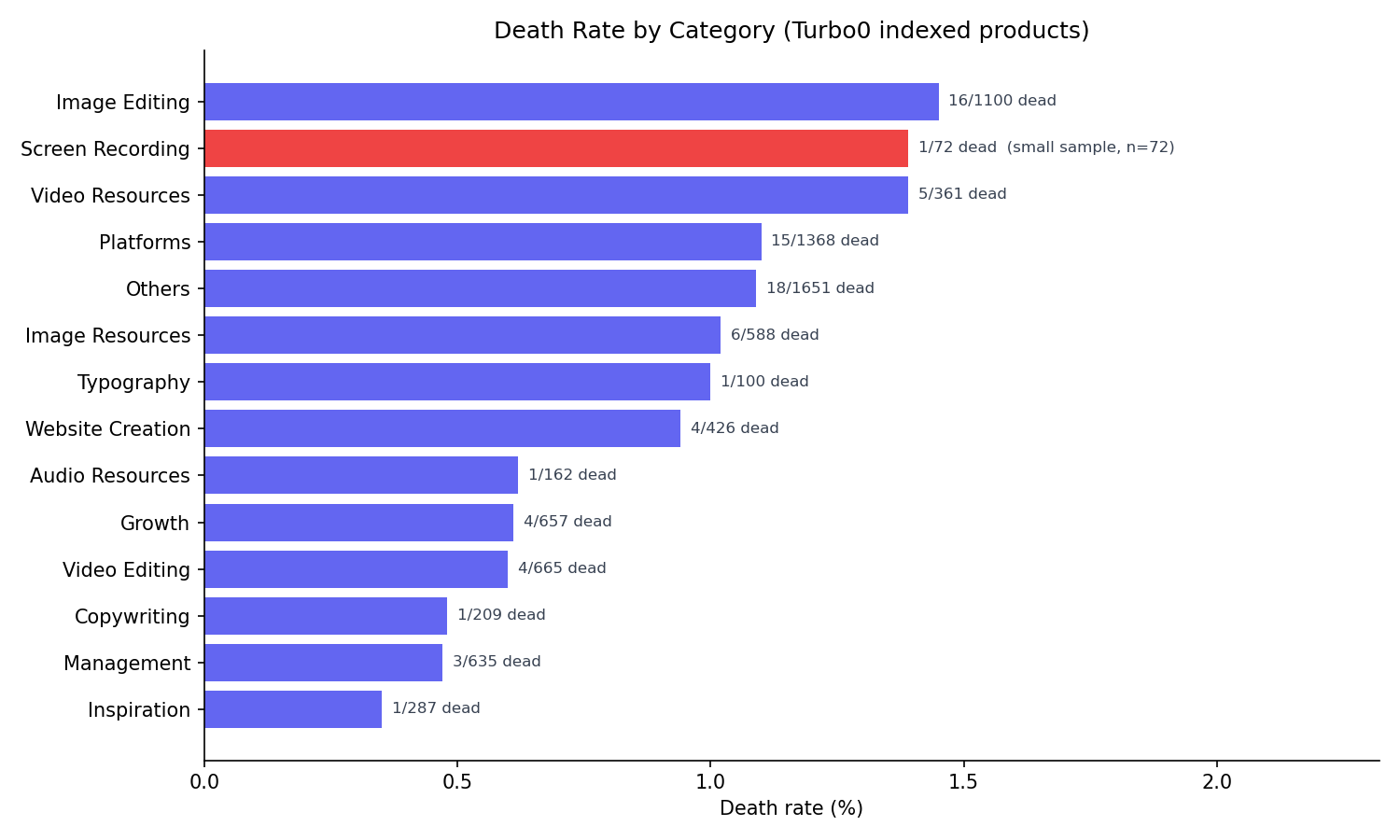 Death rate by category. Categories under 100 total listings are flagged — a single death moves their rate a lot, so treat those numbers as directional, not conclusive.
Ranked by rate instead of count, one category stands out with both a high rate and a large enough sample to trust: Image Editing, at 1.45% (16 dead out of 1,100 listed) — the highest rate among any category with a meaningful sample, and not close. The next comparable one, Platforms, sits at 1.10% off a similarly large base (1,368 listings).
Two other categories technically post similar or higher rates — Screen Recording and Video Resources, both 1.39% — but need a footnote. Screen Recording's rate comes from a single dead product out of only 72 listed: one data point wearing a percentage sign, not a trend. Video Resources is sturdier (5 dead out of 361) but still thin next to Image Editing's sample. We're flagging this rather than treating all three as equally proven.
The practical read: Image Editing is the one category where we can say, with real confidence, that competition and turnover are unusually high. It's also one of Turbo0's most crowded categories, likely no coincidence — a flood of AI-powered image tools launched over the past year, many built on the same handful of underlying models, competing almost entirely on UI and pricing rather than any defensible moat. That's not a reason to skip the category — it's a reason to have a specific answer for why you'll still be running when a dozen similar competitors aren't.
How Long Do They Actually Survive?
For each dead product we have an estimated survival window — time from launch to confirmed shutdown. Across all 74:
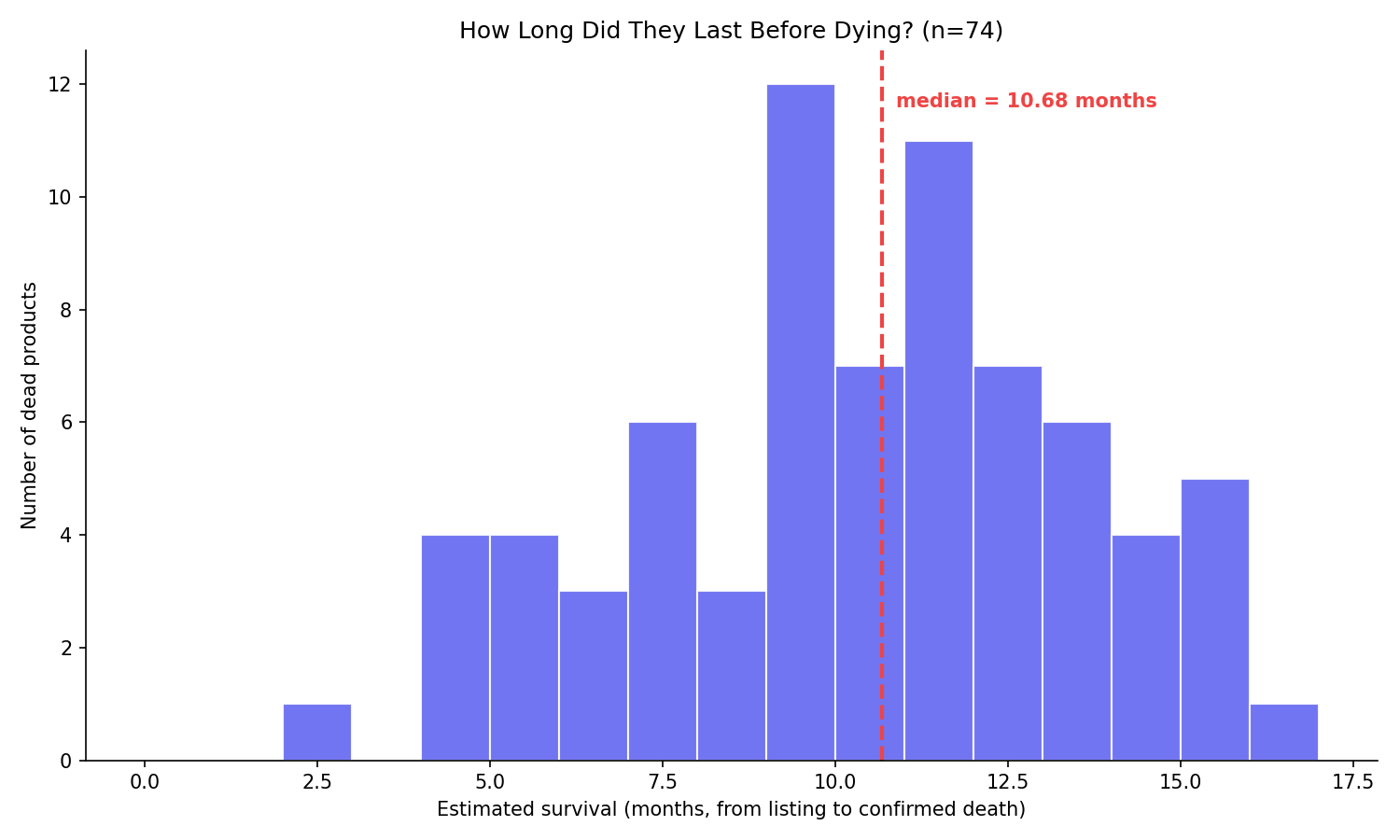 Estimated survival time in months for the 74 confirmed-dead products. The dashed line marks the median: 10.68 months.
- Minimum: 2.42 months
- p25: 8.33 months
- Median: 10.68 months
- p75: 12.79 months
- p90: 14.34 months
- Maximum: 16.51 months
- Mean: 10.35 months
A few things jump out. First, the median is under a year — half of the products that eventually died didn't make it to their first anniversary. Second, the spread between p25 and p90 — 8.33 to 14.34 months — is a tight six-month band holding the middle 80% of all deaths. Almost nothing survived past 16.5 months, and almost nothing died in the first two months either: the failure mode here isn't "abandoned on day one," it's "ran for roughly a year, then quietly stopped."
That pattern lines up with a familiar arc: launch, get an initial traffic bump (a directory listing, a Product Hunt post, an early SEO win), coast on it for several months, then — without a compounding channel or revenue that covers hosting and time — wind down between month 8 and month 15. If your product is past that window and still running, the data suggests you've cleared the highest-risk stretch — not that you're safe, but that you've outlasted most of what didn't make it.
Pricing Model and Death: A Correlation, Not a Verdict
Here's the pricing breakdown across the 74 dead products:
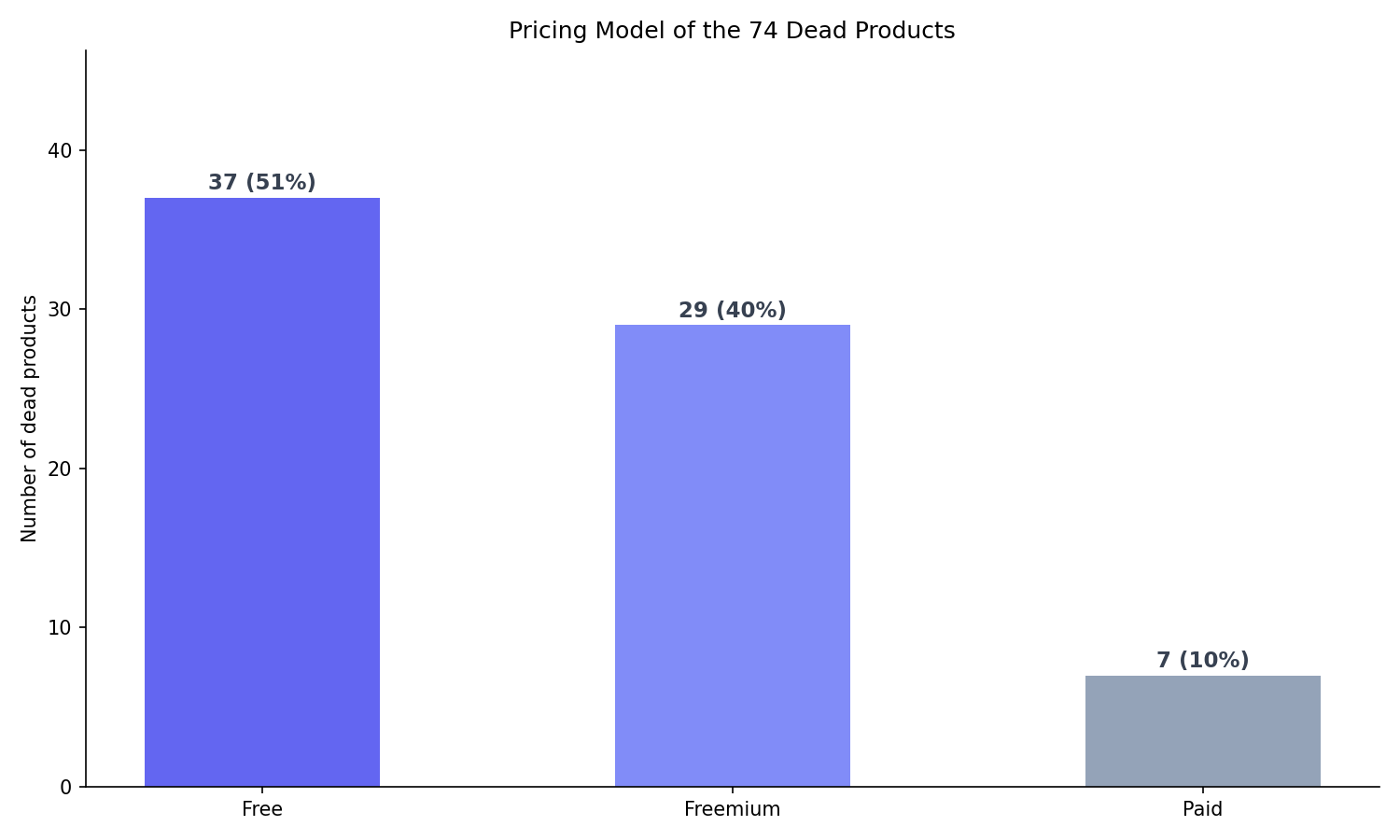 Pricing tags on the 74 dead products. Free products make up just over half of all confirmed deaths.
- Free: 37 products (51%)
- Freemium: 29 products (39%)
- Paid: 7 products (9%)
It's tempting to read this as "paid products are safer," and the raw numbers are consistent with that story — free products make up more than half of everything that died, paid products less than a tenth. A fully free tool has no revenue line; it survives entirely on the maker's willingness to keep paying for hosting and maintenance with zero return, a much weaker foundation than even a small trickle of subscription revenue.
But we want to avoid overclaiming causation: we don't know the pricing-model split of the surviving 6,026 products, and free tools are almost certainly the largest slice of the whole directory, not just the dead pool. If, say, 55% of all 6,100 listings are free, then free products dying at 51% of the dead-pool rate might just reflect their share of the population, not elevated risk. Paid having the fewest deaths (7) may likewise reflect that far fewer products here are Paid to begin with, not that charging money is shutdown-proof.
What we can say without overreaching: shipping with zero monetization built in removes the single biggest reason a maker keeps paying attention once the initial excitement fades. Even a Freemium tier — one paying customer, one signal that someone cares — changes the incentive to keep the lights on. The data doesn't prove "charge money and you'll survive," but it's consistent with "no revenue path at all is one more reason a project gets abandoned around month 10."
Five Products, Briefly
Names and numbers, without commentary beyond what the data shows:
- Pain Signal (Freemium, Growth) — the shortest-lived product here, running an estimated 2.42 months before shutdown.
- Unblur Image (Freemium, Image Editing) — an AI image-sharpening tool, one of the 16 Image Editing deaths, lasted about 4.2 months.
- Beam Video (Paid, Video Resources) — a rare paid-tier death, survived an estimated 9.94 months, roughly in line with the median.
- Screenrecorder.me (Free, Screen Recording) — the single confirmed death in that category (out of 72 listed), lasted about 15.1 months, well above the median.
- NuxtBase (Paid, Website Creation) — the longest survivor in this dataset at an estimated 16.51 months; even a paid model and the longest run we've confirmed eventually still ended.
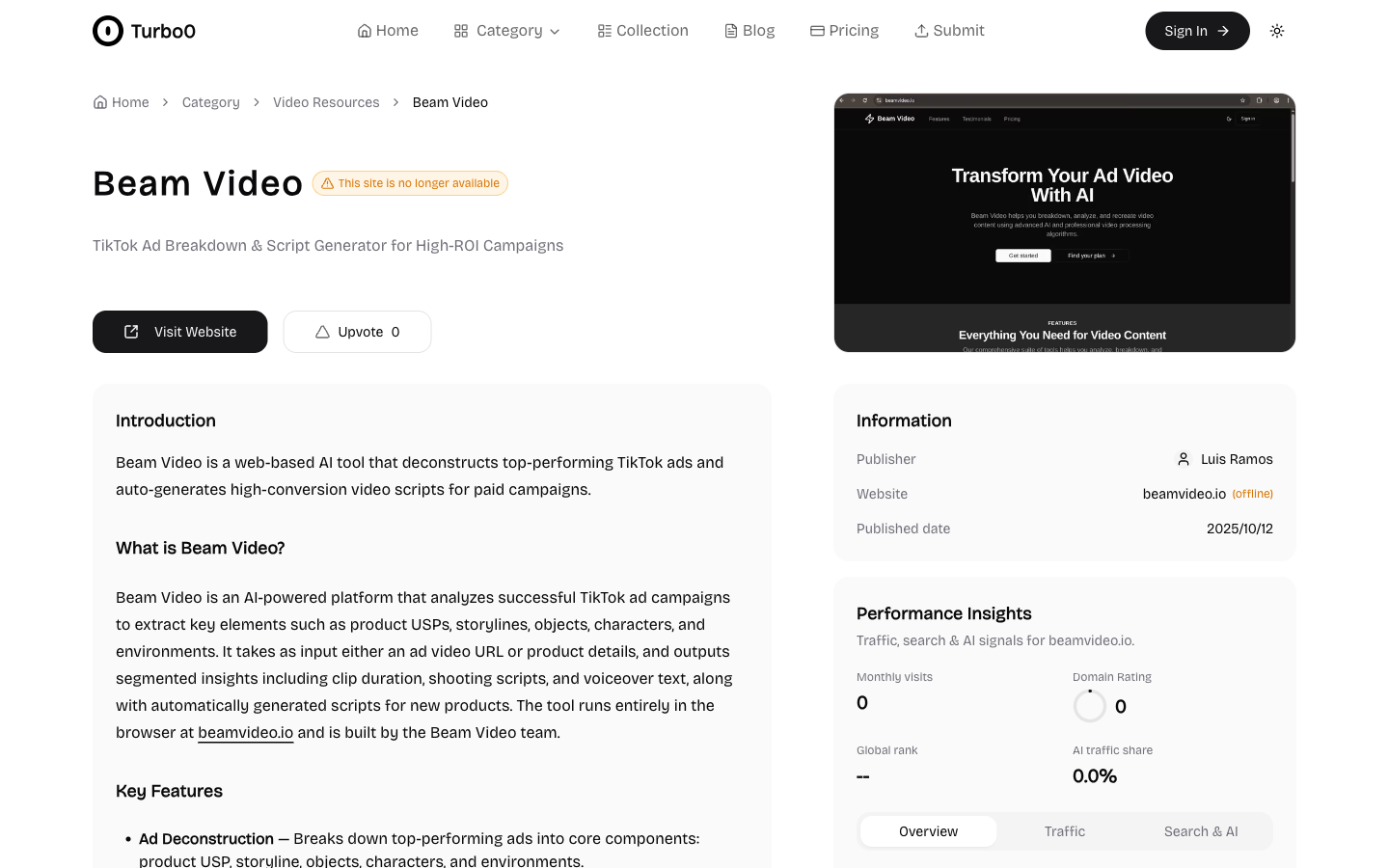 Beam Video's Turbo0 listing today — the dead-site badge and the
 nofollow treatment described above, applied to a real product.
 A Wayback Machine snapshot of beamvideo.io from December 18, 2025 — the last look at the product before it went dark.
 NuxtBase's Turbo0 listing — the longest-surviving product in this dataset (16.51 months), still eventually marked dead.
These aren't cautionary tales in the mocking sense — most were reasonably built tools solving real, if narrow, problems. They're just data points in a distribution most indie products eventually fall somewhere in.
One More Angle: When Were They Born
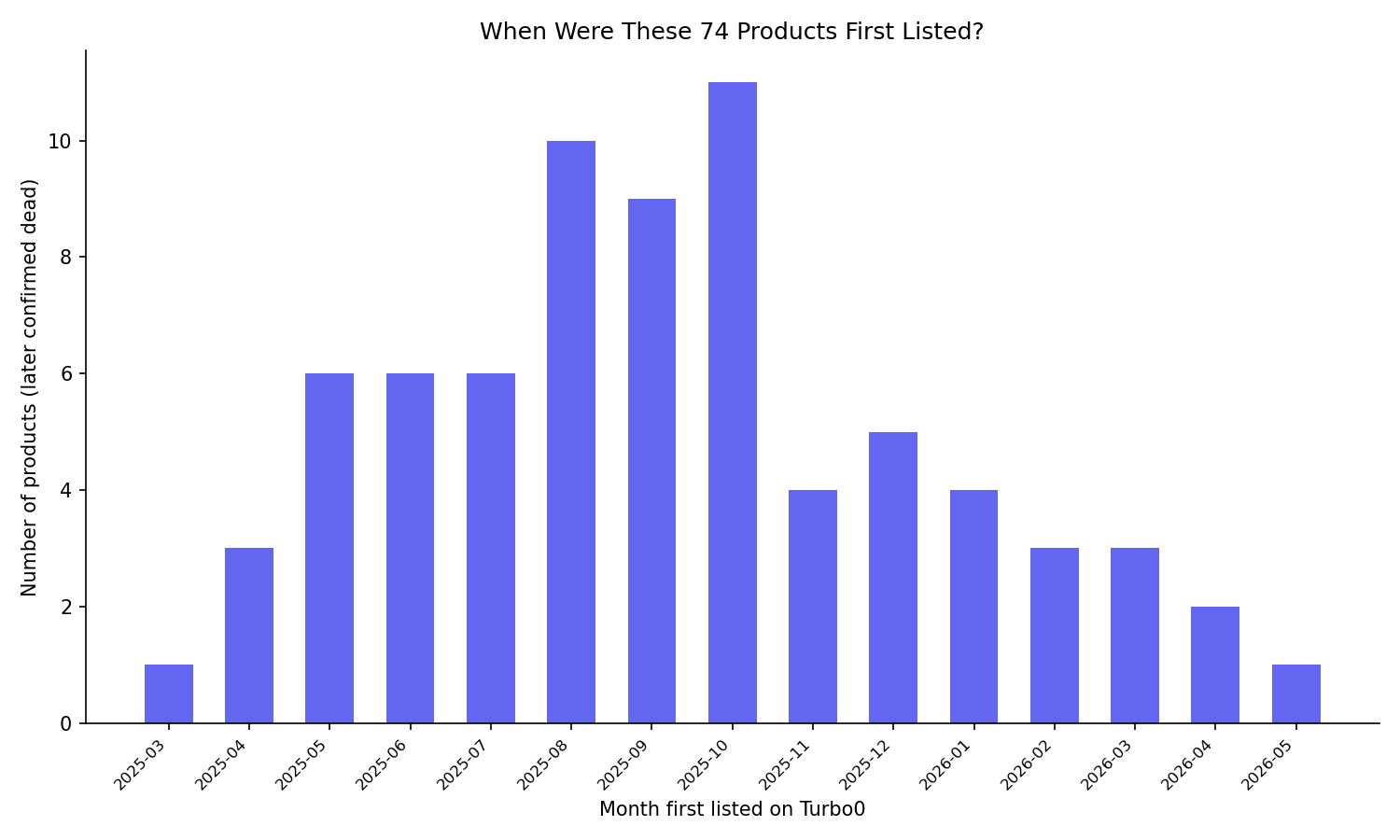 Month each of the 74 dead products was first listed on Turbo0 — this tracks our own listing volume more than anything else, so read it as context, not a mortality trend.
The cluster around August–October 2025 mostly reflects when Turbo0 itself listed more products, not a riskier launch window. It does mean most of these 74 launched within the last year and a half, consistent with the 10.68-month median — we're catching deaths close to real time, not sifting a decade of history.
What This Actually Teaches an Indie Maker
Pulling the threads together, here's what the data supports — not generic startup advice, but conclusions tied to these 74 products:
- Month 8 through month 15 is your danger zone. With p25 at 8.3 months and p90 at 14.3 months, most failures here happened in that window — not immediately, rarely after 16 months. Heading into your first year without a plan for what keeps things running past month 10 is the risk this data flags.
- A zero-revenue model isn't automatically fatal, but it removes your safety margin. Free products account for 51% of confirmed deaths. We can't prove causation given the unknown baseline, but the implication holds regardless: build in at least one signal of real demand — a paid tier, a waitlist that converts — before launch traffic fades, since it rarely sustains a project past year one.
- Be honest about how crowded your category already is. Image Editing has both a large enough sample and a high enough death rate to call competition there unusually brutal — 16 deaths out of 1,100 listings, triple the rate in categories like Growth or Video Editing. Not a reason to skip image tools; a reason you need a specific answer for why users pick yours over a dozen near-identical wrappers.
- Small-sample death rates can mislead — check the denominator before trusting a scary statistic, including some in this article. Screen Recording's 1.39% rate is one product out of 72. Don't let a single data point talk you out of, or into, a category.
If you're building an indie tool, Turbo0 tracks all 6,100 of these products — dead and alive — and you're welcome to submit your own. We'd rather see you in the "alive" column a year from now than in a future version of this report.